
TERESA TAF
Teresa TAF (Teresa Adão da Fonseca) was born in Porto. She holds a Master’s degree in Fine Arts from the Faculty of Fine Arts of the University of Porto, where she was recognised for her academic excellence and artistic work. She has lived, travelled and studied in different countries, undertaking artistic residencies in Paris (FR), Barcelona (ES), Sydney (AU), the Red Center (AU) and Lisbon (PT). The diversity of these experiences runs through her work, bringing together references that she incorporates into her practice as a multidisciplinary artist. Her research into organic and sustainable materials has sparked a deep curiosity for ancestral techniques and natural processes. She seeks to create spaces for contemplation where matter, time and gesture intertwine, reflecting on identity, the feminine, landscape and care, in a constant search for origins. She regularly exhibits her work, which is held in public and private collections in Portugal and abroad.
*
How would you describe your practice? Through my artistic practice, I approach that which has not yet been revealed. In this movement, I seek a way of Being-with-the-World. Perhaps, at its core, it is an attempt to approach the origin of things and, through it, to also approach myself. A search that, over time, has become an investigation into Being itself, with the world and with others. It was in this sense that I began to understand my practice as an ontological journey. To dive in order to encounter the deepest light. When I dive, I move through a liminal state between the known and the unknown. It is in this interval, between what I know and what has not yet been revealed, that the body and matter meet, and where something can begin to transform. It is in this interval that something transforms, between what we are and what we may still become. In this movement, this passage towards something that lies beyond, I allow something to be revealed.
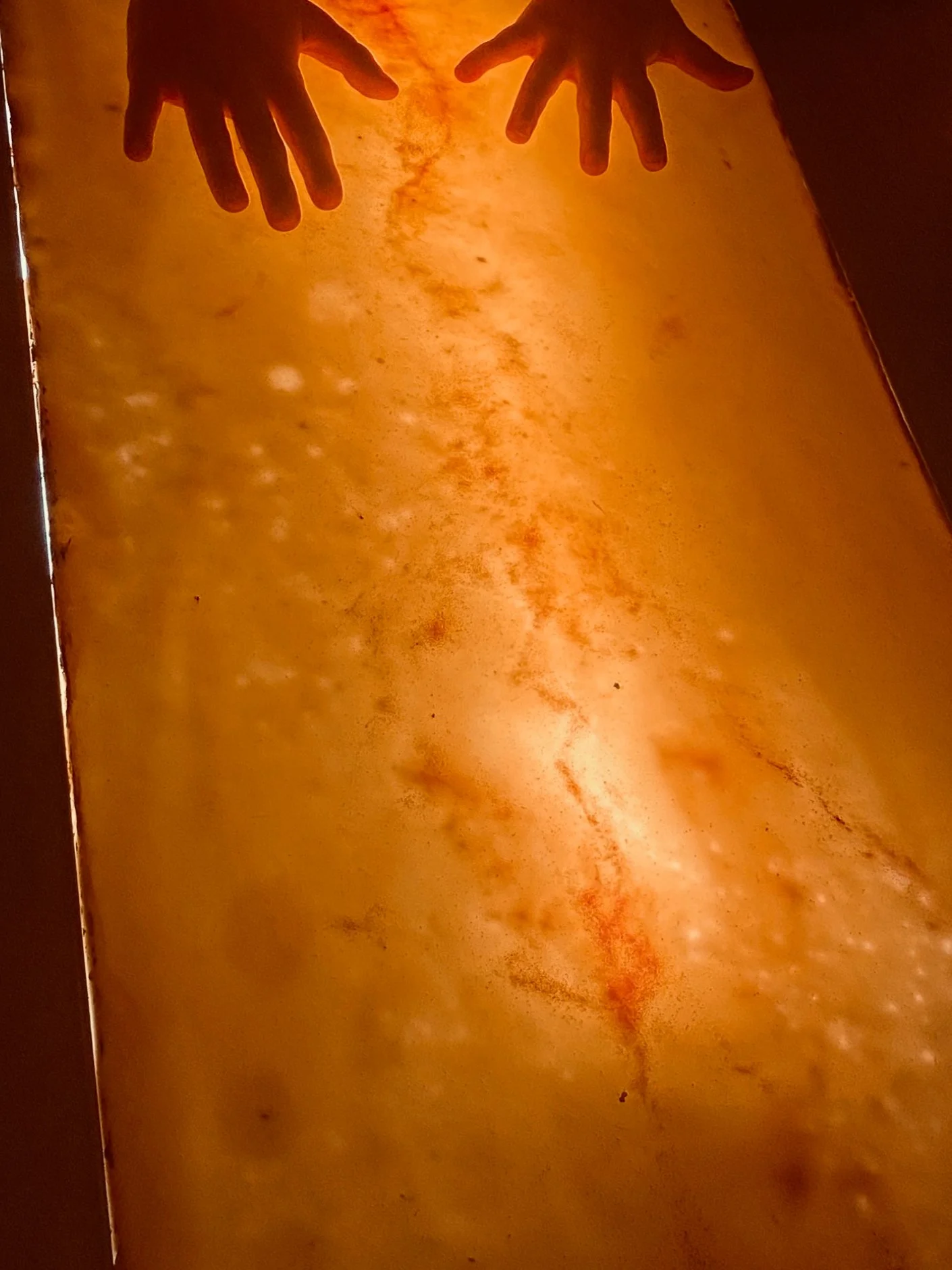
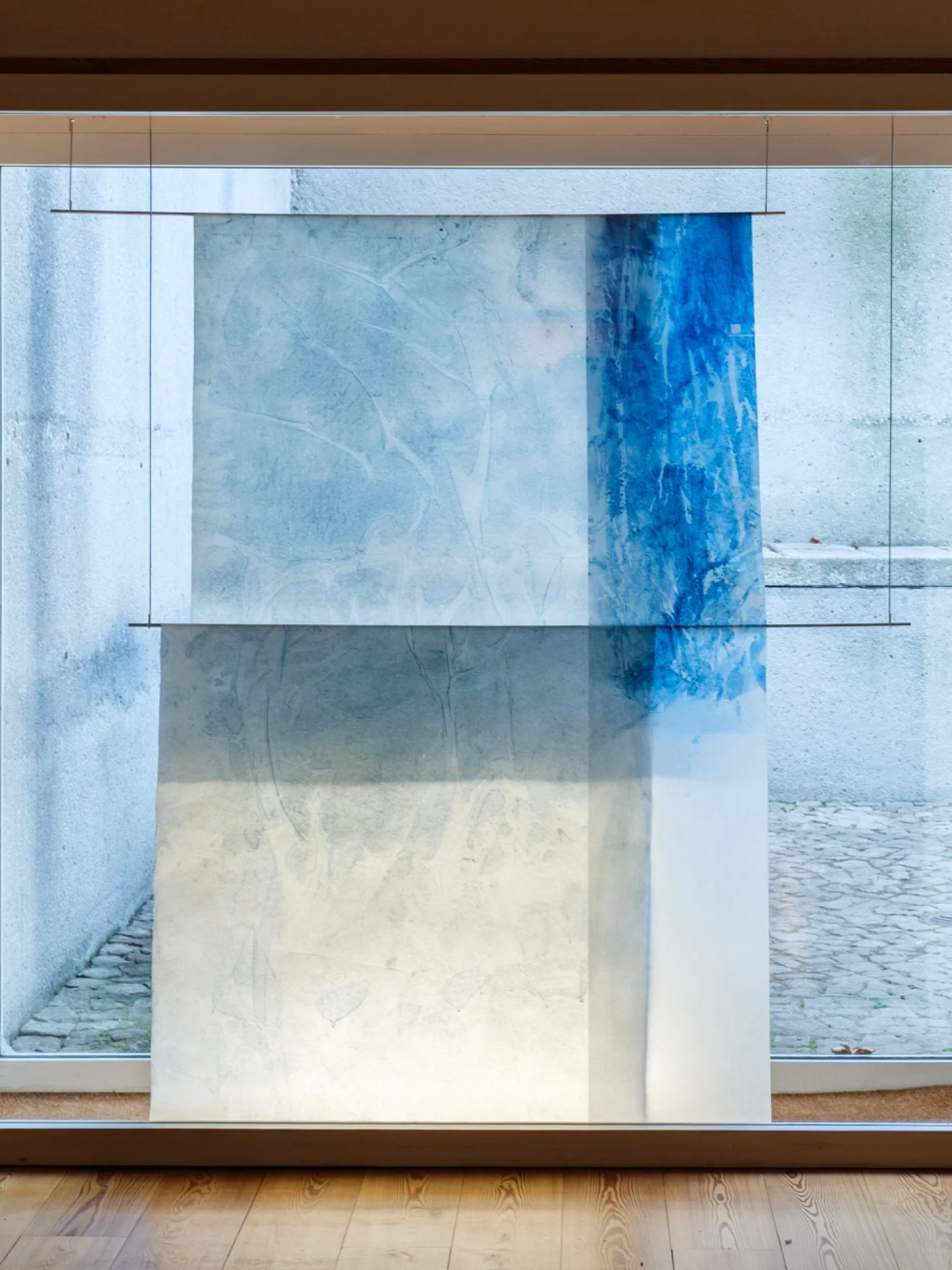
How do you define your work process? My working process begins long before the studio. It begins with looking. I have learned a great deal through the travels I have made, the territories I have encountered, the cultures and practices I have come across, but also through museums, literature and, above all, painting. From an early age, cultural trips with my parents and, later, artistic residencies that gave me the possibility of being confronted with other cultures and other ways of making, were building within me a kind of archive of images, gestures and experiences. Today I realise that many of these things are still present in my practice, even when I am not consciously seeking them. Over the years, this process has also changed. The experience of becoming a mother, adult life, commitments and spending more time in my own city have given the studio another place. Today there is space to dive more slowly, to read, talk, think, observe and also to be in silence. Perhaps I have learned that searching does not only happen when we move. It can also happen when we remain. Travel continues, nevertheless, to be important. The recent experience of being in Italy, in Tuscany, for example, made me look again at the painting and sculpture of so many masters with renewed attention. There is a kind of knowledge that is acquired simply by being in front of the works. Knowing how to look is also a practice. Then, in the studio, this gaze encounters matter. And that is where another part of the process begins. Archiving, listening and initiating a process of alchemy through a close relationship with these materials. There is desire, attention and intention, but there is also something that I do not know and cannot entirely control. It is precisely this zone of relationship that interests me, where not everything is decided beforehand. It is also here that the territory becomes present again. The materials I choose are not neutral. Indigo, wine sediments, beeswax, pigments extracted from the earth or from plants, fabrics and colour itself carry with them a place, a time, a memory and, often, forms of knowledge and ways of making that come from long before me. I am interested in approaching these materials through these forms of knowledge, listening to them and understanding what they may still reveal. Intuition plays an important role here. I do not think of it as something separate from knowledge, but as a form of knowing that is created over time, through experience and through the act of making itself. There are things I recognise before I know how to explain them. Trust. The work happens in this way, through approximations. I make, observe, go back, alter, abandon, return. I often move in a loop. One thing leads to another and, many times, a work opens up a question that only later do I realise I was asking. It is in this openness that we walk towards the light, which illuminates and, at the same time, can make us “blind” along the way. This is how we approach the essential and the sensitive, and open new doors of thought and creation. Perhaps the process is, at its core, a permanent negotiation between intention and listening, between what I seek and what the material gives back to me. Accepting that the process itself may lead me somewhere I had not anticipated. It is in this movement, between what I seek and what happens, that the work truly begins to come alive.
How does narrative emerge in your work? The narrative is already there. Before me. It is in the material, in the territory, in time, but also within us, in something that already inhabits us before we are able to understand or explain it. Perhaps my work is, in part, an attempt to recognise what already exists before giving it a name. When I approach a material, I do not begin from an empty surface onto which I will construct a story. I seek to create a relationship with it. The material carries with it a place, a time, a memory, and I enter into a relationship with it. There is also something that happens within us in this encounter, a form of knowledge that is sometimes felt before it can be thought or explained. The narrative emerges through this movement. There is what I seek, what I intuit, what the material gives back to me, and also what I still cannot understand. As in the writing of Clarice Lispector, I am interested in that place where thought is still living matter, where thinking is not simply about explaining, but about allowing something to happen. It is in this space in-between that the fissure interests me. Like an opening, an interval, a place where something can be revealed. The fissure is not yet what we know; it is precisely the space that opens between one thing and another. The scar is something else. It is the trace of a passage, a mark that remains on the body after a transformation. It interests me because it holds a memory without being merely memory; it carries with it what happened, but also the possibility of continuing to transform. Perhaps this is why I do not seek to close the narrative of my works. I am interested in them remaining sufficiently open for each person to enter them through their own experience, their memory and their body. The work contains the traces of a relationship, but it does not determine what the other person should find. Ultimately, the narrative happens in this encounter, between what was already there, what I recognise and what each gaze may still reveal.
To what extent do “error” or chance play a part in your practice? Chance happens if we are open to error. What we often consider a failure, a defect or something that should be corrected can, precisely, be the place where something opens up. Within error remains the greatest freedom. I think of the fissure, that place that interrupts what was expected and creates an empty space. It is there that something that was not programmed can emerge, something new and unpredictable. In nature, it is precisely in the small cracks, in the places that have not been domesticated, that we find the plants that grow more freely, more spontaneously, closer to a wild nature. Perhaps it is also there that we can rediscover ourselves as more original and free beings. A few months ago I took part in a workshop with an artist, where we were challenged to think about failure. That experience made me look even more closely at the things we so often want to correct, hide or make perfect. I increasingly want to remain close to these failures, to understand what happens within them, because it may be precisely there that there is space to transform, deepen and dive. I think this also goes beyond the artistic work itself. We increasingly live according to a logic of control, prediction, programming and correction. We want to control the body, time, the image, behaviours, results. The more absolute the control, the less space there is for what is alive, singular and unpredictable. And perhaps it is precisely in what escapes control that a possibility of freedom remains. This is where chance enters my work. I do not seek it as a method, nor as a way of abandoning intention. Chance happens within a relationship that has already been built, between myself, the material, the gesture and what I am seeking. What appears to be an accident can open up a possibility that I would not have been able to imagine on my own. As I mentioned earlier, this is also where intuition becomes important. One needs to be present in order to recognise that opening. Not everything that happens should be followed, but there are moments when something is revealed in a fissure and we know, before we are able to explain why, that we should remain there. Perhaps it is a question of being attentive to the present moment, to the total immersion. It is in this state of attention that we can find and recognise narratives that were already there. Motherhood also played an important role in this search of mine for origins and for these approaches. It taught me another relationship with time, with waiting and with creation. To create is to accept that we cannot completely determine what is born. There is surrender, care, doubt and a yielding to the unexpected. A work, like life, needs this space in order to find its own time. This is why I think that error opens a fissure in control and, within that fissure, freedom, possibility, life and that which has not yet been programmed appear.
Teresa TAF (Teresa Adão da Fonseca), nasceu no Porto. É mestre em Artes Plásticas pela Faculdade de Belas Artes da Universidade do Porto, tendo sido distinguida pela sua excelência académica e pelo seu trabalho artístico. Viveu, viajou e estudou em diferentes países, realizando residências artísticas em Paris (FR), Barcelona (ES), Sydney (AU), Red Center (AU) e Lisboa (PT). A diversidade destas experiências atravessa a sua obra, reunindo referências que integra na sua prática como artista multidisciplinar. A investigação com materiais orgânicos e sustentáveis despertou uma profunda curiosidade pelas técnicas ancestrais e pelos processos da natureza. Procura criar espaços de contemplação onde matéria, tempo e gesto se entrelaçam, refletindo sobre a identidade, o feminino, a paisagem e o cuidado, numa constante busca pelas origens. Expõe regularmente e as suas obras integram coleções públicas e privadas em Portugal e no estrangeiro.
*
Como descreverias a tua prática? Através da prática artística, aproximo-me daquilo que ainda não se revelou. Procuro, nesse movimento, uma forma de Ser-com-o-Mundo. Talvez seja, no fundo, uma tentativa de me aproximar da origem das coisas e, através dela, de me aproximar também de mim. Uma procura que se foi tornando, ao longo do tempo, uma investigação sobre o próprio Ser com o mundo e com os outros. Foi neste sentido que comecei a compreender a minha prática como um percurso ontológico. Mergulhar para ir ao encontro da luz mais profunda. Quando mergulho, atravesso um estado liminal entre o conhecido e o desconhecido. É nesse intervalo, entre aquilo que conheço e aquilo que ainda não se revelou, que o corpo e a matéria se encontram e onde alguma coisa pode começar a transformar-se. É nesse intervalo que alguma coisa se transforma, entre aquilo que somos e aquilo que ainda podemos vir a ser. Neste movimento, nesta passagem em direção a algo que está mais além, permito que alguma coisa se revele.
Como caracterizas o teu processo de trabalho? O meu processo de trabalho começa muito antes do atelier. Começa no olhar. Aprendi muito através das viagens que fiz, dos territórios que conheci, das culturas e práticas com que me fui cruzando, mas também através dos museus, da literatura e, sobretudo, da pintura. Desde muito cedo, as viagens culturais com os meus pais e mais tarde as residências artísticas que me deram a possibilidade de estar diante de outras culturas e de outras formas de fazer foram construindo em mim uma espécie de arquivo de imagens, gestos e experiências. Hoje percebo que muitas dessas coisas continuam presentes na minha prática, mesmo quando não as procuro conscientemente. Ao longo dos anos, esse processo também se foi transformando. A experiência de ser mãe, a vida adulta, os compromissos e uma permanência maior na minha cidade fizeram com que o atelier ganhasse outro lugar. Hoje há espaço para mergulhar mais devagar, para ler, conversar, pensar, observar e também para o silêncio. Talvez tenha aprendido que procurar não acontece apenas quando nos movemos. Também pode acontecer quando permanecemos. As viagens continuam, ainda assim, a ser importantes. A experiência recente de estar em Itália, na Toscana, por exemplo, fez-me voltar a olhar para a pintura e escultura de tantos mestres com uma atenção renovada. Há um conhecimento que se adquire simplesmente por estar diante das obras. Saber olhar é também uma prática. Depois, no atelier, esse olhar encontra a matéria. E é aí que começa outra parte do processo. Arquivar, escutar e iniciar um processo de alquimia através de uma relação próxima com essas matérias. Há desejo, atenção e intenção, mas também há qualquer coisa que desconheço e que não posso controlar inteiramente. Interessa-me precisamente essa zona de relação, onde nem tudo está decidido à partida. É também aqui que o território volta a estar presente. As matérias que escolho não são neutras. O índigo, as borras de vinho, a cera de abelha, os pigmentos extraídos da terra ou das plantas, os tecidos e a própria cor transportam consigo um lugar, um tempo, uma memória e, muitas vezes, formas de conhecimento e de fazer que vêm de muito antes de mim. Interessa-me aproximar-me dessas matérias através desses saberes, escutá-los e perceber o que ainda podem revelar. A intuição tem aqui um papel importante. Não a penso como algo separado do conhecimento, mas como uma forma de saber que se cria com o tempo, através da experiência e do próprio fazer. Há coisas que reconheço antes de saber explicá-las. Confiar. O trabalho vai acontecendo assim, por aproximações. Faço, observo, volto atrás, altero, abandono, retomo. Ando muitas vezes em loop. Uma coisa leva a outra e, muitas vezes, uma obra abre uma pergunta que só mais tarde consigo perceber que estava a fazer. É nessa disponibilidade que caminhamos em direcção à luz, que clareia e, ao mesmo tempo, nos pode tornar “cegos” no caminho. É assim que nos aproximamos do essencial sensível e abrimos novas portas de pensamento e criação. Talvez o processo seja, no fundo, uma negociação permanente entre intenção e escuta, entre aquilo que procuro e aquilo que a matéria me devolve. Aceitar que o próprio processo me possa conduzir para um lugar que não tinha previsto. É nesse movimento, entre o que procuro e aquilo que acontece, que o trabalho começa verdadeiramente a ganhar vida.
De que forma surge a narrativa no teu trabalho? A narrativa já está lá. Antes de mim. Está na matéria, no território, no tempo, mas também em nós, em qualquer coisa que já nos habita antes de a conseguirmos compreender ou explicar. Talvez o meu trabalho seja, em parte, uma tentativa de reconhecer aquilo que já existe antes de lhe dar um nome. Quando me aproximo de uma matéria, não parto de uma superfície vazia sobre a qual vou construir uma história. Procuro criar uma relação com ela. A matéria traz consigo um lugar, um tempo, uma memória, e eu entro em relação com ela. Há também qualquer coisa que acontece dentro de nós nesse encontro, um conhecimento que por vezes se sente antes de poder ser pensado ou explicado. A narrativa vai surgindo nesse movimento. Há aquilo que procuro, aquilo que intuo, aquilo que a matéria me devolve e também aquilo que ainda não consigo compreender. Como na escrita de Clarice Lispector, interessa-me esse lugar em que o pensamento ainda é matéria viva, onde pensar não é apenas explicar, mas deixar acontecer alguma coisa. É nesse espaço entre que a fenda me interessa. Como uma abertura, um intervalo, um lugar onde algo se pode revelar. A fenda não é ainda aquilo que sabemos, é justamente o espaço que se abre entre uma coisa e outra. A cicatriz é outra coisa. É o vestígio de uma passagem, uma marca que permanece no corpo depois de uma transformação. Interessa-me porque guarda uma memória sem ser apenas memória, traz consigo aquilo que aconteceu, mas também a possibilidade de continuar a transformar-se. Talvez seja por isso que não procuro fechar a narrativa das minhas obras. Interessa-me que permaneçam suficientemente abertas para que cada pessoa possa entrar nelas a partir da sua própria experiência, da sua memória e do seu corpo. A obra contém os vestígios de uma relação, mas não determina aquilo que o outro deve encontrar. No fundo, a narrativa acontece nesse encontro, entre o que já estava lá, aquilo que eu reconheço e aquilo que cada olhar ainda pode revelar.
Até que ponto o “erro” ou o acaso fazem parte da tua prática? O acaso acontece se estivermos disponíveis para o erro. Aquilo que muitas vezes consideramos uma falha, um defeito ou algo que deve ser corrigido pode ser, precisamente, o lugar onde alguma coisa se abre. No erro permanece a maior liberdade. Penso na fenda, nesse lugar que interrompe o previsto e cria um espaço vazio. É aí que pode surgir aquilo que não estava programado, algo novo e imprevisível. Na natureza, é precisamente nas pequenas brechas, nos lugares que não foram domesticados, que encontramos as ervas que crescem mais livres, mais espontâneas, mais próximas de uma natureza selvagem. Talvez seja também aí que nos possamos reencontrar enquanto seres mais originais e livres. Há poucos meses fiz um workshop com uma artista, onde fomos desafiados a pensar sobre a falha. Essa experiência fez-me olhar ainda com mais atenção para aquilo que tantas vezes queremos corrigir, esconder ou tornar perfeito. Tenho cada vez mais vontade de permanecer junto dessas falhas, de perceber o que acontece dentro delas, porque pode ser justamente aí que existe espaço para transformar, aprofundar e mergulhar. Penso que isto ultrapassa também o próprio trabalho artístico. Vivemos cada vez mais numa lógica de controlo, de previsão, de programação, de correcção. Queremos controlar o corpo, o tempo, a imagem, os comportamentos, os resultados. Quanto mais absoluto é o controlo, menos espaço existe para o que é vivo, singular e imprevisível. E talvez seja precisamente naquilo que escapa ao controlo que permanece uma possibilidade de liberdade. É aí que o acaso entra no meu trabalho. Não o procuro como um método, nem como uma forma de abdicar da intenção. O acaso acontece dentro de uma relação que já está construída, entre mim, a matéria, o gesto e aquilo que procuro. O que parece um acidente pode abrir uma possibilidade que eu não teria conseguido imaginar sozinha. Como já disse anteriormente, é também aí que a intuição se torna importante. É preciso estar presente para reconhecer essa abertura. Nem tudo o que acontece deve ser seguido, mas há momentos em que alguma coisa se revela numa fenda e sabemos, antes de conseguir explicar porquê, que devemos permanecer ali. Talvez seja uma questão de estar atento ao momento presente, ao mergulho total. É nesse estado de atenção que podemos encontrar e reconhecer narrativas que já estavam lá. A maternidade teve também um papel importante nesta minha procura pelas origens e por estas aproximações. Ensinou-me uma outra relação com o tempo, com a espera e com a criação. Criar é aceitar que não podemos determinar completamente aquilo que nasce. Há entrega, cuidado, dúvida e uma cedência ao inesperado. Uma obra, tal como a vida, precisa desse espaço para encontrar o seu próprio tempo. É por isso que penso que o erro abre uma fissura no controlo e, nessa fissura, aparece a liberdade, a possibilidade, a vida e aquilo que ainda não foi programado.
