
MARIA SOUTO DE MOURA
The practice of MARIA SOUTO DE MOURA revolves around the idea of space, present in both architecture and painting. While in architecture this space is real, inhabitable, and measurable, in painting it emerges in a free and autonomous way. Gradually, these two dimensions draw closer: through composition, geometry, and a relationship with place, painting moves beyond the surface and begins to engage the viewer in a sensory experience shaped by scale, light, and materiality.
*
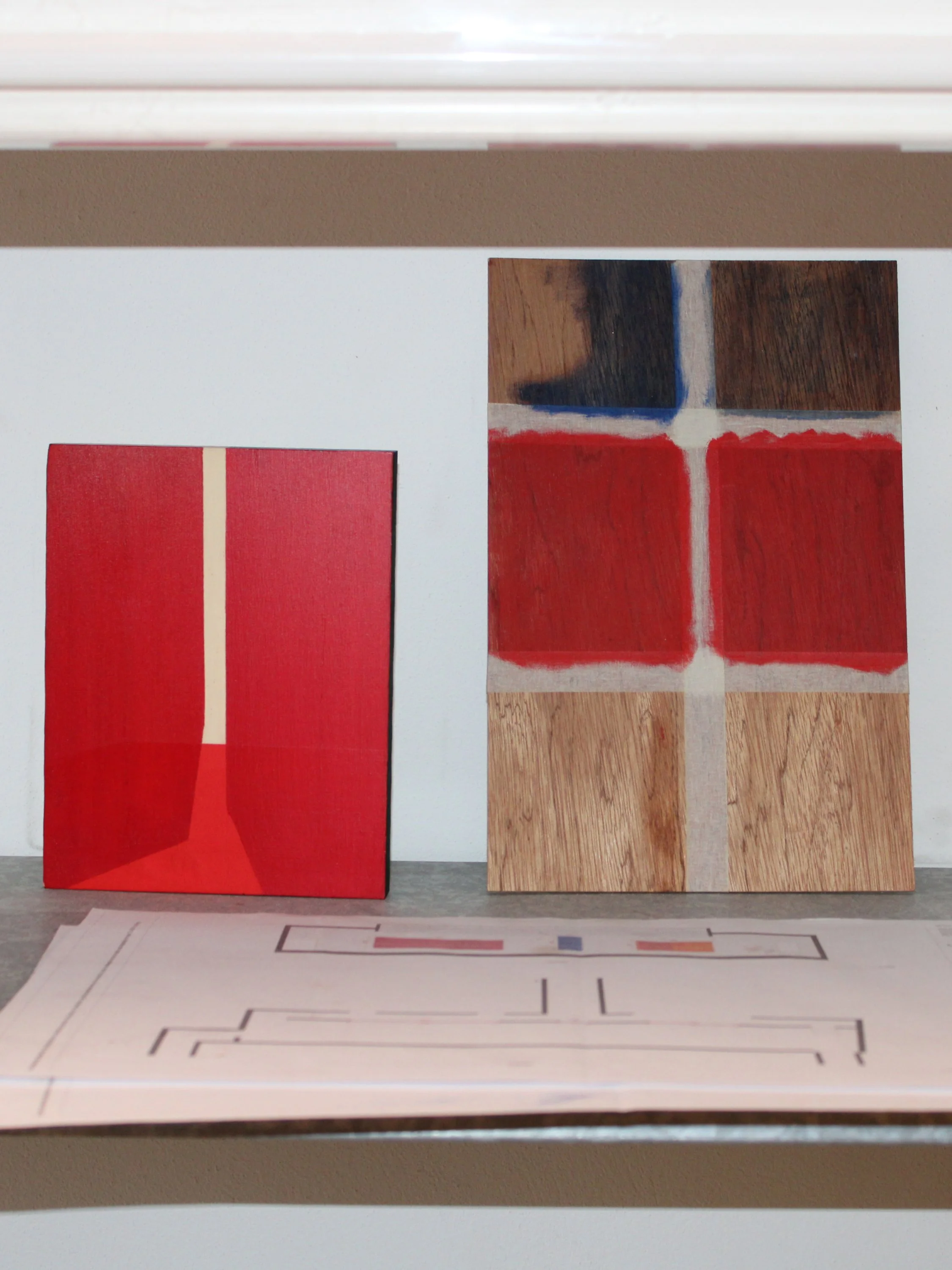
How would you describe your practice? My practice almost always emerges wrapped in an idea of space, which appears unconsciously and in various ways, both in the exercise of architecture and in my artistic practice, and therefore stands out as the central element of the creative process. With very different results, in architecture, it is always a real and inhabitable space, with precise dimensions in order to be built. In painting, it stems from a free, autonomous practice devoid of any function. However, these two manifestations of space have gradually moved closer and now occupy similar meanings as an exercise. At first, space appears as a two-dimensional void, through whiteness or the raw presence of the support, via the unpainted areas. The oscillation between matter and emptiness, along with the contrast of colours, accentuates the depth of the work. This is achieved through actions from the field of three-dimensionality, such as perspective, twisting, displacement, and contrast between chromatic planes, which establish an abstract yet spatial language. In some cases, this dimension is reinforced by the use of three-dimensional elements combined with the flat surface of the painting. Progressively, space acquires both a conceptual and a phenomenological dimension by transcending the surface of the painting and relating to the surrounding space. Space ceases to be abstract and becomes a concrete element of the work, with context, scale and measurements, capable of immersing the viewer in a place and time that are inseparable.
How do you define your work process? In my working process, there is a natural affinity between art and architecture. If, on the one hand, the question of composition influences the development of architectural projects, functioning as a means to arrive at the drawing, in the opposite direction, this effect becomes even more evident. The tools used in the architectural design process are one of the starting points for artistic creation. Composition and geometry are abstract means shared in the exercise of both disciplines. This abstraction, which functions as a common ground between architecture and painting, allows me, unconsciously, to work in a kind of open dialogue between painting and space.
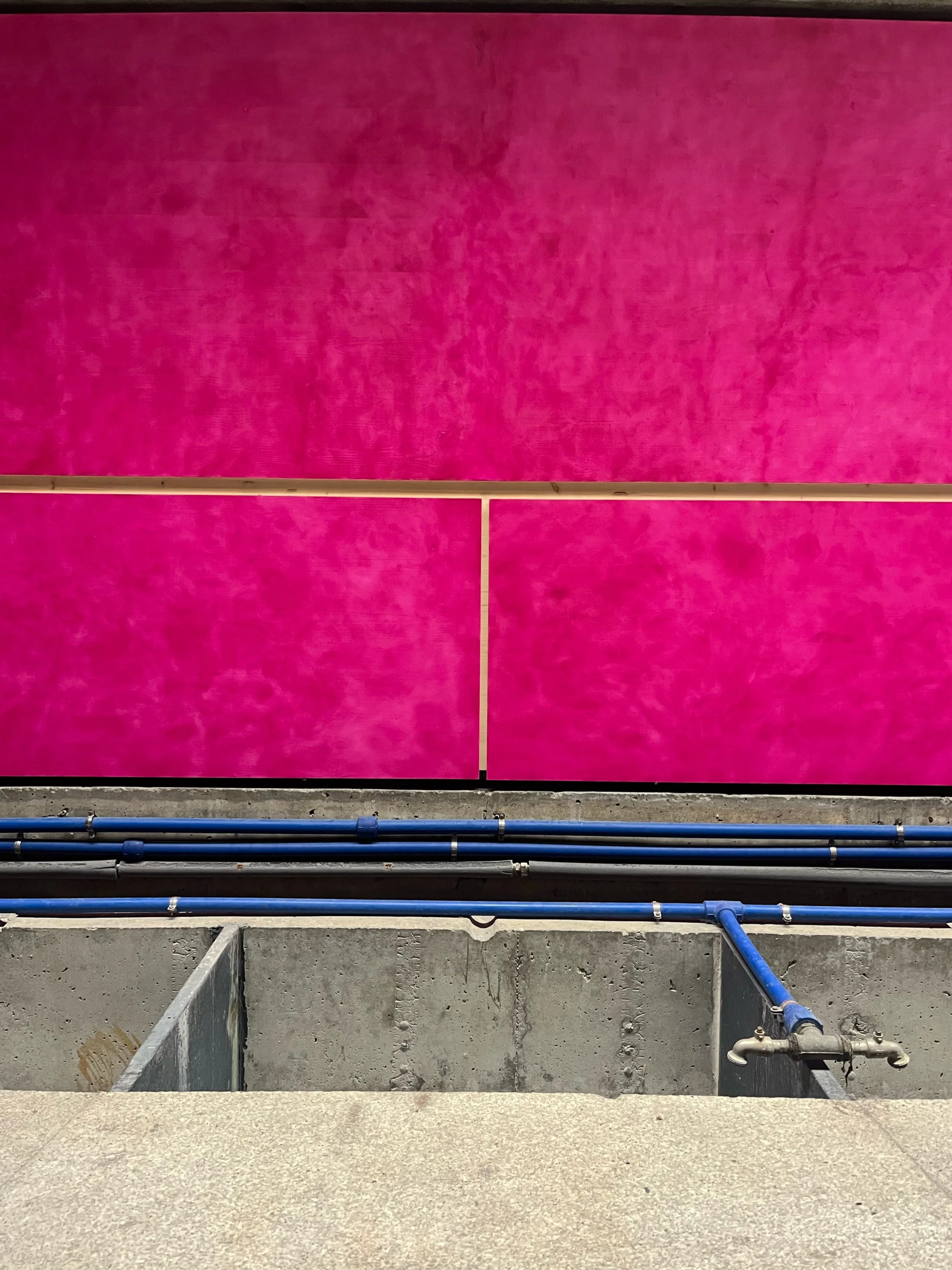
How does narrative emerge in your work? In works conceived for a specific space, as was the case with xyz, that narrative is staged/created. This intervention establishes a three-dimensional dialogue with the place. In this process, I was interested in understanding how painting could go beyond its merely contemplative character and become part of a conceptual and even bodily experience, involving other senses. The viewer’s perception is thus mediated by the space and all its inherent characteristics. Scale, materiality, sound and light itself contribute to the creation of a singular atmospheric effect. Space also becomes a theme of the painting itself, insofar as it draws on elements present in its surroundings. These attributes establish the links between the painting and the space that hosts it, in a continuous and unique dialogue.
To what extent do “error” or chance play a part in your practice? Error is a very strong concept to be applied to artistic practice, which is, by nature, subjective. Who defines the existence of an error? The artist? There are works that turn out less well, both in terms of the idea and its execution, but which are fundamental as part of the process for creating future works. Chance and condition/constraint are part of my work. Chance appears almost as an act of irony because sometimes, in an idea that has already been carefully thought through, during execution, a false movement of the hand can surprise us and trigger a new idea. I remember once when I was using a cutting knife to score a line on a canvas and, suddenly, I pierced it. I immediately thought: this must surely be what happened to Lucio Fontana. I laughed. As for condition/constraint, these appear as small provocations throughout the process, which end up enhancing the final result. In the work xyz, the initial idea was to fill three existing openings with the three primary colours. However, the size of the paintings on wooden support became a problem due to the impossibility of transporting them into the contemplative space. Thus, the painting had to be divided into several pieces that would allow it to be assembled on site. The question then became: how to divide the painting? A guard rail, an element present in the space and in the openings themselves—now covered—was used as the motif for dividing the painting. The joining of the panels corresponds rigorously to the design of this element. This composition is thus born from the conditions and constraints of the place, which thereby become an integral part of the work.
A prática de MARIA SOUTO DE MOURA desenvolve-se em torno da ideia de espaço, presente tanto na arquitetura como na pintura. Se na arquitetura esse espaço é real, habitável e mensurável, na pintura surge de forma livre e autónoma. Progressivamente, as duas dimensões aproximam-se: através da composição, da geometria e da relação com o lugar, a pintura ultrapassa a superfície e passa a envolver o espetador numa experiência sensorial, marcada por escala, luz e materialidade.
*
Como descreverias a tua prática? A minha prática surge quase sempre envolta de uma ideia de espaço, que aparece inconscientemente e de diferentes formas, tanto no exercício da arquitetura como na minha prática de artista, e por isso destaca-se como o elemento central do processo criativo. Com resultados muito diferentes, na arquitetura é sempre um espaço real e habitável, com dimensões precisas para ser construído. Na pintura decorre de uma prática livre, autónoma e desprovida de qualquer função. Contudo, estas duas manifestações de espaço foram-se aproximando e ocupam sentidos próximos enquanto exercício. Num primeiro momento, o espaço surge como um vazio bidimensional, através do branco ou da presença crua do suporte, por intermédio dos espaços por pintar. A oscilação entre matéria e vazio e o contraste da cor acentuam a profundidade da obra, através de ações do campo da tridimensionalidade, tais como perspetiva, torção, deslocamento e contraste entre os planos cromáticos, que estabelecem uma linguagem abstrata, mas espacial. Em alguns casos, essa dimensão é reforçada pelo uso de elementos tridimensionais combinados com a superfície plana da pintura. Progressivamente, o espaço adquire uma dimensão tanto conceptual como fenomenológica, ao transcender a superfície da pintura e relacionar-se com o espaço envolvente. O espaço deixa de ser abstrato e passa a assumir-se como um elemento concreto da obra, com contexto, escala e medidas, capaz de envolver o espetador num lugar e num tempo indissociáveis.
Como caracterizas o teu processo de trabalho? No meu processo de trabalho, há uma afinidade natural entre a arte e a arquitetura. Se, por um lado, a questão da composição influencia o desenvolvimento dos projetos de arquitetura, funcionando como um meio para chegar ao desenho, no sentido inverso este efeito torna-se ainda mais evidente. As ferramentas utilizadas no processo do projeto arquitetónico são um dos pontos de partida para a criação artística. A composição e a geometria são meios abstratos partilhados no exercício das duas disciplinas. Esta abstração, que funciona como um lugar-comum entre a arquitetura e a pintura, permite-me, inconscientemente, trabalhar numa espécie de diálogo aberto entre a pintura e o espaço.
De que forma surge a narrativa no teu trabalho? Nas obras concebidas para um espaço específico, como foi o caso da xyz, essa narrativa é encenada/criada. Esta intervenção estabelece um diálogo tridimensional com o lugar. Interessou-me, neste processo, perceber de que forma a pintura poderia ultrapassar o seu carácter meramente contemplativo e passar a fazer parte de uma experiência conceptual e até corporal, que envolvesse outros sentidos. A apreensão por parte do espetador passa, assim, a ser mediada pelo espaço e por todas as suas características inerentes. A escala, a materialidade, o som e a própria luz contribuem para a criação de um efeito atmosférico singular. O espaço torna-se também tema da própria pintura, na medida em que esta vai buscar elementos presentes na sua envolvente. São esses atributos que estabelecem os vínculos entre a pintura e o espaço que a acolhe, num diálogo contínuo e singular.
Até que ponto o “erro” ou o acaso fazem parte da tua prática? Erro é um conceito muito forte para ser aplicado à prática artística, que é, por natureza, subjetiva. Quem define a existência de um erro? O artista? Existem trabalhos que correm menos bem, tanto ao nível da ideia como da concretização, mas que são fundamentais enquanto processo para a criação de trabalhos futuros. O acaso e a condição/condicionante fazem parte do meu trabalho. O acaso surge quase como um ato de ironia, porque, por vezes, numa ideia já muito pensada, durante a execução, um movimento em falso da mão pode surpreender-nos e desencadear uma nova ideia. Recordo-me de uma vez em que estava com um x-ato a vincar uma linha numa tela e, de repente, furei-a. Pensei imediatamente: de certeza que foi isto que aconteceu ao Lucio Fontana. Ri-me. No que diz respeito à condição/condicionante, estas surgem como pequenas provocações ao longo do processo, que acabam por potenciar o resultado final. Na obra xyz, a ideia inicial era preencher três vãos existentes com as três cores primárias. No entanto, a dimensão das pinturas em suporte de madeira tornou-se um problema, pela impossibilidade de as transportar para o interior do espaço contemplativo. Assim, a pintura tinha de ser dividida em várias peças que permitissem a sua montagem no local. A questão passou a ser como dividir a pintura? Utilizou-se a guarda, um elemento presente no espaço e nos próprios vãos, agora tapada, como motivo de divisão da pintura. A junção dos painéis corresponde rigorosamente ao desenho deste elemento. Esta composição nasce, assim, a partir das condições e condicionantes do lugar que se tornam, deste modo, parte integrante da obra.
