

RENATO CHORÃO
INTERVIEW TWENTY-FOUR
RENATO CHORÃO’s photographic practice unfolds as a fragile yet attentive gaze upon the everyday, moving between autobiography and autofiction in order to question memory, identity, and interpersonal relations. His work often emerges from a diaristic archive of images, shaped by personal and cultural influences.
*
How would you describe your practice? Through photography, I seek to establish a careful and fragile gaze upon my daily life. My work takes on a diaristic register, navigating between autobiography and autofiction, as an attempt to understand and organize everything that surrounds me, and to reflect on interpersonal relationships, identity, and the world. In this sense, issues related to family, religion, and sexuality are deeply present in my subconscious, and they end up “contaminating” all of my work.
How do you define your work process? I feel that I work in a fluid, intuitive, and intimate way. As a continuation of my diaristic practice, I work with the accumulation of images: I collect, archive, and constantly revisit photographs that accompany my everyday life. Projects emerge from there: through an exercise of association between photographs from my archive and the ideas, thoughts, and experiences I am living at that moment. In retrospect, perhaps unconsciously, my gaze is already shaped by all those previous layers: traumas and memories. The intersection between the internet and pop culture is a constant influence in my research. In my most recent projects, Sharing is Caring and I no longer go out at night with my friends, I have been reflecting on the migrations between analog/digital as a possible regression: the return to analog in a moment when everything around us increasingly inhabits the digital space. In this process, I am interested in understanding how I can decode that (digital) space and appropriate its references in a tangible way. I have mostly been working within the format of publications and zines, but recently I have been exploring other processes and mediums such as printmaking, embroidery, and acrylic.
How do you work with memory and archive in your practice? I believe that working with photography means constantly working with memory and archive, even if unconsciously. I found in the process of photographing an extension of my memory, but also a way to work for the memory of spaces, moments, and people with whom I cross paths. As I mentioned earlier, I am constantly revisiting my archive. And it is in this process that my works emerge, resulting in “new archives” such as One Night Stand (2020), or Souvenirs from Romania (2021), which are formally archives of two different experiences; or even in We’re not in hell, but very far from heaven (2022), which ends up being a more fluid and conceptual work in this sense, composed of photographs that arose from previous projects.
Which image you have created so far comes closest to perfection for you? The first image that came to my mind as soon as I read this question was a photograph I took in Rio de Janeiro at a bar called “Cantinho Maranhense.” I was shooting 35mm with a point-and-shoot camera. When I pressed the shutter, I thought: “I really hope this photo captures exactly what I’m seeing”, and it did. For some reason, that photograph was important to me, at that moment.
Finally, what are you currently working on? At the moment, I am working on my project I no longer go out at night with my friends, within the context of the Project Rooms program of the Porto Photography Biennale. This project will result in a publication, which I hope to edit soon. Lately, I have also felt the urge to continue my correspondence project Sharing is Caring.

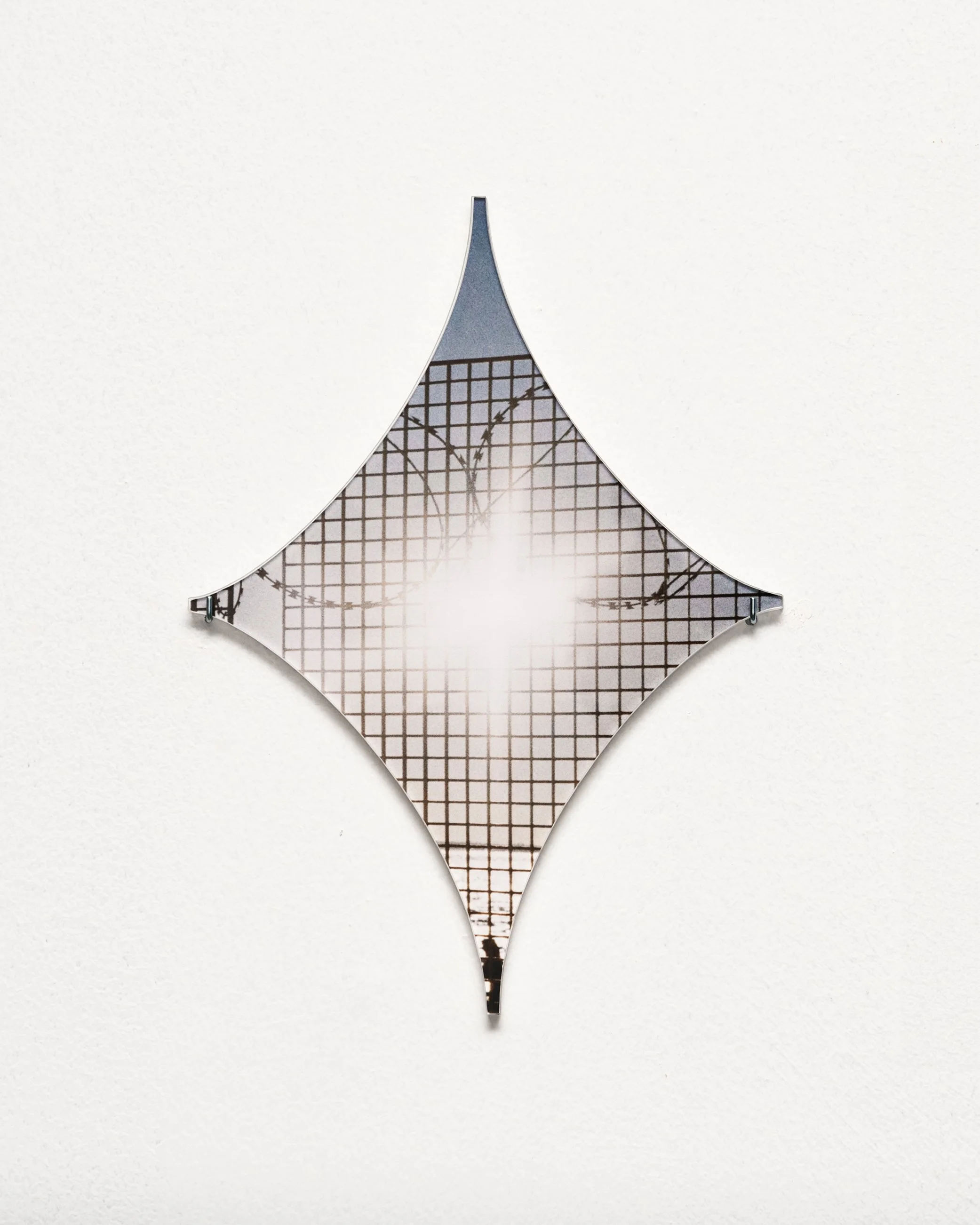
RENATO CHORÃO desenvolve a sua prática fotográfica como um olhar atento e frágil sobre o quotidiano, movendo-se entre a autobiografia e a autoficção para questionar a memória, a identidade e as relações interpessoais. O seu trabalho nasce frequentemente de um arquivo diarístico de imagens, moldado por influências pessoais e culturais.
*
Como descreverias a tua prática? Através da fotografia procuro estabelecer um olhar atento e frágil sobre o meu quotidiano. O meu trabalho assume um registo diarístico, que navega entre a autobiografia e autoficção, como uma tentativa de compreender e organizar tudo que me rodeia; e refletir sobre as relações interpessoais, a identidade e o mundo. Nesse sentido, questões relacionadas com a família, a religião e a sexualidade estão muito presentes no meu subconsciente, e acabam por “contaminar” todo o meu trabalho.
Como caracterizas o teu processo de trabalho? Sinto que trabalho de uma forma fluida, intuitiva e íntima. Como continuação da minha prática diarística, trabalho com a acumulação de imagens: recolho, arquivo e revisito constantemente fotografias que acompanham o meu quotidiano. Os projetos surgem a partir daí: através de um exercício de associação entre fotografias do meu arquivo com ideias, pensamentos e experiências que estou a viver naquele momento. Em perspetiva, talvez de forma inconsciente, o meu olhar já esteja moldado por todas essas camadas anteriores: os traumas e as memórias. A interseção entre a internet e a cultura pop são uma influência constante na minha pesquisa. Nos meus projetos mais recentes, “Sharing is Caring” e “Já não saio à noite com as minhas amigas”, tenho pensado sobre as migrações entre analógico/digital como um possível retrocesso: o regresso ao analógico num momento em que tudo o que nos rodeia cada vez mais habita o espaço digital. Neste processo interessa-me perceber como posso descodificar esse espaço (digital) e apropriar-me das suas referências de um modo tangível. Tenho trabalhado maioritariamente no formato de publicação e zines, mas recentemente tenho vindo a explorar outros processos e suportes como a estampagem, o bordado e o acrílico.
De que forma trabalhas a memória e arquivo no teu trabalho? Acredito que trabalhar com fotografia é estar constantemente a trabalhar sobre memória e arquivo, ainda que de forma inconsciente. Encontrei no processo de fotografar uma extensão da minha memória, mas também de trabalhar para a memória dos espaços, momentos, e pessoas com as quais me cruzo. Como mencionei anteriormente, estou constantemente a revisitar o meu arquivo. E é neste processo que surgem os meus trabalhos, que resultam em “novos arquivos” como em One Night Stand (2020), ou Souvenirs from Romania (2021), que formalmente são arquivos de duas experiências diferentes; ou até mesmo em We’re not in hell, but very far from heaven (2022), que acaba por ser um trabalho mais fluído e conceptual nesse sentido, composto por fotografias que surgem de trabalhos anteriores.
Qual a imagem que criaste até agora que se aproxime para ti à perfeição? A primeira imagem que me veio à cabeça assim que li esta pergunta foi uma fotografia que fiz no Rio de Janeiro num bar chamado “Cantinho Maranhense”. Estava a fotografar em 35mm e a utilizar uma point-and-shoot. Quando pressionei o obturador pensei “Espero mesmo que esta fotografia capte exatamente isto que estou a ver”, e ficou. Por alguma razão aquela fotografia era importante para mim, naquele momento.
Por último, em que estás a trabalhar atualmente? Neste momento estou a trabalhar no meu projeto “Já não saio à noite com as minhas amigas”, no contexto do programa Project Rooms, da Bienal de Fotografia do Porto. Deste projeto surgirá uma publicação, que espero editar em breve. Ultimamente também tenho tido vontade de dar continuidade ao meu projeto de correspondência “Sharing is Caring”.

SUSANA ROCHA
INTERVIEW TWENTY-THREE
SUSANA ROCHA is a multidisciplinary artist whose work explores the emotional and physical tensions arising from personal experiences, while also aiming to connect with a broader audience. She focuses on themes such as anxiety, grief, and fear, using materials like rubber, glass, and metal to evoke the body's responses and limitations.
*
How would you describe your practice? As a constant search to translate tensions that, despite arising from my singular experience, don't necessarily tell a biography. This has also been the challenge: to be able to identify the boundary between a private emotional/psychological universe and metaphors or interpretations that, if not universal, are at least possible to echo. In this search, I focus on issues related to some internal disruption: anxiety, grief, loss, inability, failure, or fear. And their various physical translations. The body is our common ground. Our emotions are highly variable, but the body through which we experience them is not that different (reflexes, physiology, basic needs...). Materials, as a field of research and experimentation, with symbolic potential, or with "human" characteristics, have also occupied a relevant place in my practice. Rubber replacing muscle or as part of a mechanism, glass representing bone or as a scientific material, metal as an ancient material for structure, aggression, or ornament... are quick examples. These concepts, which are inscribed in our psyche, interest me quite a lot.
How do you define your work process? The beginning is always the same: wanting to work on a particular concept and understanding how it can be materialized. This phase may involve quick sketches (I don't get too lost in drawing), research into materials, suppliers, instruments, tools, or structural solutions. I may need to learn or at least experiment with a new technique. I spend a lot of time on the computer, in the studio learning how to work, or in hardware stores. Then, just as the materials I use for the work change, so do the characteristics and timing of the most obvious completion of a project. Sometimes I know exactly what I want to do, and it's mainly about being able to execute, which may require working with others whose technical skills I'm trying to master, as it has been the case with glass; other times, it's about pure experimentation in the studio. In fact, increasingly, both dynamics coincide, because if I'm working on a more complex piece, with which I need help and where I need to respect the timing of others, I will try to simultaneously work in the studio on projects that depend solely on me. Other times, there are even projects that are kept in a drawer, mainly because they are not financially viable, but even those teach me something and somehow contribute to the process.
How did you transition from painting to three-dimensionality? It wasn't really a transition. It was a sudden and definitive break. One day, I just knew I didn't want to paint anymore. I needed a more tangible relationship with the production, a broader physical engagement: stretching, twisting, piercing, cutting, constructing, disassembling. I wanted to talk about things I couldn't think of through painting. At the same time, during the period when I stopped painting, I needed, for personal reasons, to work in a more project-based way: the advances and setbacks of painting, the feeling of going beyond the surface into the canvas (which is part of why the process it's so extraordinary for painters, and for me too, was a challenge) I was no longer willing to embrace. In any case, it wasn't a traumatic break. I knew there were many other things I wanted to do. It seemed strange to me that after all my training in painting, I began working with unfamiliar materials. Still, I discovered that this kind of limitation, or constriction, is an aspect that has become fundamental to my practice. These difficulties, or even inabilities, are anchors and limit my choices of materials and techniques, which is a relief. Still, painting is absolutely structural in the way I look at art. And I always feel very captivated observing certain kinds of painting.
Your works develop around tensions. Are they a starting point or a consequence of the process? They are always a starting point, and often a consequence of the process. In that respect, I have a somewhat symbiotic functioning. The first tension is the result of some introspective restlessness that drives me to work; the second arises naturally as a characteristic of the way I work. I don't think there can be artistic production without tension. I indeed seek it in my practice, but I don't think anyone works without it, although they may give it other names. It may be a curiosity, a restlessness, a desire, a turning point. I call it tension because it is simultaneously a paradoxical gesture of tearing apart and of confrontation, within the same premise, or between two or more different premises.
Finally, what are you currently working on? I'm currently finishing a few pieces, and so everything is unfolding at an exciting pace between my studio and the studio of Maria Renée Morales Lam, who generously helps me with the glass in my work. These pieces will be part of an exhibition I'll be presenting at Plato Évora in October ("Leaking Bodies") and another exhibition at Duplex in November ("The Party is Over"). While I really want to continue working with glass, rubber, and metal, I also want to understand how to introduce sound into my work. Still, the only thing I know about sound is that it always arises from tension (or movement), that it propagates quickly, that affects us, and that I have two ears capable of hearing it.


SUSANA ROCHA é uma artista multidisciplinar com um trabalho de investigação centrado nas tensões físicas e emocionais que emergem não só da sua experiência pessoal, como da ressonância com um público mais alargado. Foca-se em temas como a ansiedade, o luto e o medo, recorre a materiais como a borracha, o vidro e o metal para traduzir as respostas e fragilidades do corpo.
*
Como descreverias a tua prática? Como uma procura constante em traduzir tensões que apesar de nascerem da minha experiência singular não denunciam necessariamente uma biografia. Esse tem sido também o desafio: delinear a fronteira entre um universo emocional / psicológico privado, e as metáforas ou leituras que, podendo não ser universalizantes, podem pelo menos ser ecoadas. Nessa procura, centro-me em questões que se relacionam com algum tipo de disrupção interna: ansiedade, luto, perda, incapacidade, fracasso, medo. E as suas diversas traduções físicas. O corpo é o terreno que todos temos em comum. As nossas emoções são altamente variáveis, mas o corpo, através do qual as experimentamos, não difere tanto assim (reflexos, fisiologia, necessidades básicas) Os materiais, como campo de pesquisa e experimentação, com potencial simbólico, ou com características “humanizáveis”, têm também ocupado um lugar relevante na minha prática. A borracha em substituição do musculo ou como parte de um mecanismo, o vidro no lugar do osso ou como material científico, o metal como material ancestral de estrutura, agressão ou ornamento. são rápidos exemplos. Esse tipo de conceitos que, de alguma forma estão inscritos na nossa psique, interessam-me muito.
Como caracterizas o teu processo de trabalho? O início é sempre o mesmo: querer trabalhar determinado conceito e perceber como é que isso é materializável. Nessa fase podem surgir esboços rápidos (não me perco muito no desenho), pesquisa de materiais, de fornecedores, de instrumentos, ferramentas ou soluções estruturais. Posso precisar de aprender ou pelo menos experimentar alguma técnica nova. Passo muito tempo ao computador, no estúdio a perceber como trabalhar ou em lojas de construção. De seguida, da mesma forma que os materiais que convoco para o trabalho vão mudando, também se vão alterando as características e os tempos da concretização mais evidente de alguma obra. Por vezes sei exatamente o que quero fazer, e trata-se sobretudo de conseguir executar (o que pode exigir trabalhar com outras pessoas com capacidades técnicas que tento assimilar, como tem sido o caso com o vidro); outras vezes trata-se de pura experimentação no estúdio. Na verdade, cada vez mais as duas dinâmicas acontecem em simultâneo, porque se estiver a trabalhar numa obra mais complexa, com a qual preciso de ajuda e onde preciso de respeitar o timing de terceiros, procuro ao mesmo tempo trabalhar no estúdio em obras que só dependem de mim. Outras vezes são até projetos que ficam na gaveta, sobretudo por não serem financeiramente viáveis... mas mesmo esses, ensinam-me alguma coisa, e participam do processo.
Como foi feita a passagem da pintura para a tridimensionalidade? Não foi bem uma passagem. Foi um corte súbito e acredito que definitivo. Um dia sabia que não queria mais pintar. Precisava de uma relação mais tangível com a produção, precisava de um envolvimento físico mais amplo: esticar, torcer, perfurar, cortar, construir, desmontar. Queria falar sobre coisas que não conseguia através da pintura. Simultaneamente, durante o período em que parei de pintar precisava, por motivos pessoais, de trabalhar de um modo mais projetual: os avanços e recuos da pintura, o sentimento de que te adentras para lá da superfície da tela (que é parte do motivo pelo qual é tão extraordinária para os pintores, e também para mim) era um desafio que não estava mais a abraçar. De qualquer forma, não foi um corte traumático. Sabia que havia muitas outras coisas que queria fazer. Pareceu-me um pouco bizarro que depois de toda a minha formação ter sido em pintura, começasse a trabalhar com materiais que não me eram nada familiares; mas descobri que esse tipo de limitação, ou de constrição, é um aspeto que se tornou basilar na minha prática. Essas dificuldades ou até incapacidades são ancoras, e limitam as minhas escolhas de materiais e técnicas, o que é um alívio. Ainda assim, acredito que a pintura é absolutamente estrutural no modo como olho para a arte. E sinto-me sempre muito seduzida na observação de alguma pintura.
As tuas obras desenvolvem-se em torno de tensões. São um ponto de partida ou uma consequência do processo? São sempre um ponto de partida, e frequentemente uma consequência do processo. Nesse aspeto, tenho um funcionamento bastante simbiótico. A primeira tensão é fruto de alguma inquietação introspetiva que me leva a trabalhar, a segunda surge naturalmente como característica do modo como trabalho. Não me parece que possa existir produção artística sem tensão. É certo que a procuro na minha prática, mas acho que ninguém trabalha sem ela, ainda que lhe possam atribuir outros nomes. Talvez seja uma curiosidade, uma inquietação, um desejo, um ponto de inflexão... seja o que for. Eu chamo-lhe tensão porque para mim é simultaneamente um gesto paradoxal de desgarre e de confronto, dentro de uma mesma premissa, ou entre duas ou mais premissas diferentes.
Por último, em que estás a trabalhar atualmente? Neste momento estou a finalizar algumas peças, e por isso tudo se desenrola com um ritmo que me entusiasma, entre o meu estúdio e o estúdio da Maria Renée Morales Lam, que tem a generosidade de me ajudar com o vidro no meu trabalho. Essas peças farão parte de uma exposição que apresentarei na Plato Évora em Outubro (“Leaking Bodies”) e de uma outra exposição que estará na Duplex em Novembro (“The Party is Over”). Embora queira muito continuar a trabalhar com vidro, borracha e metal, quero também perceber como introduzir som no meu trabalho. Só que a única coisa que sei sobre som é que nasce sempre de uma tensão (ou movimento), que se propaga rápido, que nos afeta, e que tenho dois ouvidos capazes de o ouvir.

HUGO FLORES
INTERVIEW TWENTY-TWO
HUGO FLORES explores autobiographical memory as a symbolic territory, invoking affections, traumas, and family legacies in an intimate and shared artistic gesture. Through multiple visual languages, the artist constructs a poetics where truth and fiction intersect, giving shape to an imaginary marked by repetition, attentive listening, and collaboration.
*
How would you describe your practice? My artistic practice is structured as an autoethnographic investigation, centered on the exploration of my biography as a symbolic and affective territory. It is an ongoing process of constructing meaning, in which subjectivity, family heritage, and traumatic memory are summoned as sensitive material for the work. In recent years, the presence of my family has become structural, not only in the investigative dimension but also in the operative dimension of producing the pieces. This gesture of transgenerational collaboration strains the boundaries between the intimate and the collective, the authorial and the shared, reconfiguring the studio or the home as a relational space where memory is processed and trauma finds the possibility of elaboration and, eventually, healing. My practice does not privilege a specific medium but is guided by the conceptual and sensitive needs of each project. The work manifests in multiple languages: drawing, painting, sculpture, high-relief, photography, video, and installation, rejecting disciplinary hierarchies and affirming transversality as a way of thinking and making art. In this process, the work becomes a field of presence, where body, time, and matter intertwine in a phenomenology of affect and listening.
How do you define your work process? My process begins with a gesture of introspection: a gaze directed toward autobiographical memory, where I seek to identify “corrupted files”, affective fragments. These diffuse or distorted memories resist linear narrative and totality. The decoding of these memories happens sometimes individually, sometimes in intimate collaboration with close family members, in an exercise that combines listening, sharing, and collective elaboration of the past. Along this path, symbols begin to emerge almost organically: forms, images, or gestures that reveal themselves as significant residues. I appropriate these symbols, incorporating them into my visual language in a deliberately enigmatic way. I often resort to repetition, an almost compulsive device, that refers to the logic of trauma and its insistent return. This repetition, however, also carries a ritualistic potential, functioning as an attempt at reinscription and re-signification. The choice of materials is a central stage in the process, due to their capacity to carry latent meanings, evoke sensory and affective memories, or establish tensions between presence and absence. Material, therefore, is not neutral: it is vehicle and language, body and sign, guiding both the poetics and the installation dimension of the work.
What references, images, or symbols appear in your work? The symbols that populate my work are multiple and stem from profoundly diverse contexts, intertwining personal, historical, and sometimes fictional references. They do not follow a systematic logic, but rather emerge as constellations of meaning, often intuitively, traversing memory, the imaginary, and the collective unconscious. Among these recurring elements are animals such as snakes, scorpions, blackbirds, and lions, each one imbued with symbolic layers that oscillate between the archetypal and the intimate. Objects like rulers, reeds, needles, and hammers evoke both the universe of measurement and precision and that of violence and transformation. Bodily fragments, hands, fingers, feet, appear as extensions of action, touch, and embodied memory. I also incorporate references such as song lyrics (notably from Pulp), which function as emotional triggers and narrative devices. Architectural elements, such as walls, refer to physical and symbolic barriers, evoking separations, limits, and exclusions. Mythological figures, such as Laocoön, arise as metaphors of shared suffering and tragic resistance.
To what extent do truth and fiction intertwine in the autobiographical dimension of your works? In my practice, truth and fiction do not oppose each other, but rather coexist in an ambiguous and fertile zone that characterizes the autobiographical dimension. Memory, as raw material for the work, is not a neutral repository of facts but an unstable, fragmentary field subject to reconstruction, both conscious and unconscious. In this sense, what is "remembered" is inevitably shaped by processes of affectation, forgetting, desire, and projection. The symbols I use, whether animals, bodily fragments, everyday objects, or mythological figures, function as poetic devices that condense subjective experiences. Instead of representing “facts” from my history, they stage zones of affection, trauma, desire, or belonging. Many of them emerge from a shared process with members of my family, where testimony and invention intertwine in a space of listening and creation. Fiction, in this context, is not an escape from truth, but a way of fabulating it: of giving form to what cannot be said directly. As Roland Barthes proposes, the “I” of autobiographical discourse is always a construction, an enunciated subject that unfolds and (re)invents itself. My practice deliberately embraces this condition, exploring the autobiographical as a territory where truth and fiction overlap to generate meanings that are both personal and shareable.
Finally, what are you currently working on? Collaborative work has become an increasingly present and structuring dimension in my practice. In particular, the collaboration with my mother has introduced new layers of meaning, a conscious shift toward lighter atmospheres, at times even humorous, that contrast with the emotional density that often permeates my production. This gesture of opening to humor and tenderness implicitly invokes a critique of defense mechanisms and the often ineffective methods of emotional, familial, or social protection. It is a shared vulnerability, which translates visually into poetic strategies of symbolic disarmament. Soon, I will be participating in a group exhibition at Centro Cultural Vila Flor, in dialogue with works by Luísa Abreu and Teresa Arêde.

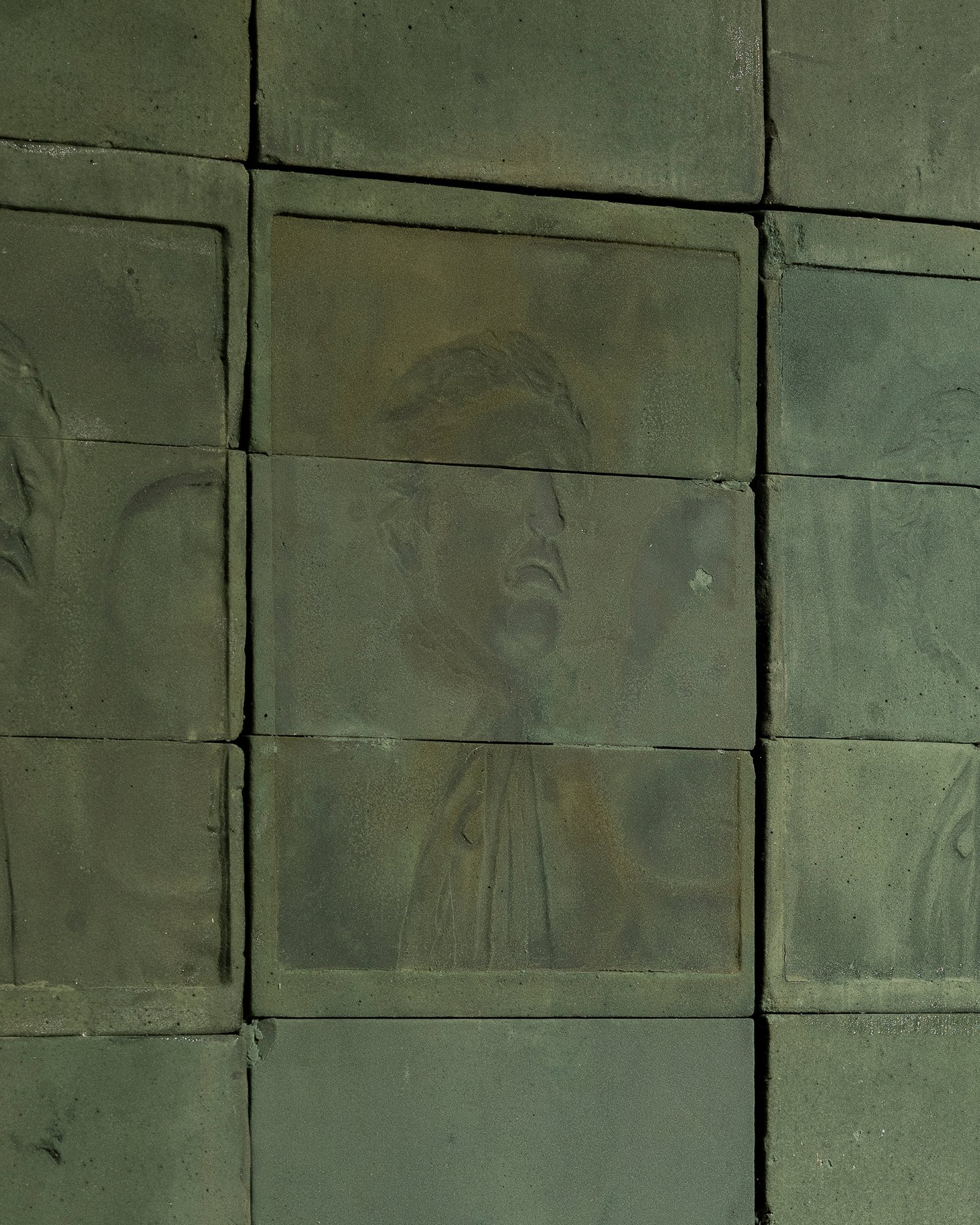
HUGO FLORES explora a memória autobiográfica como território simbólico, convocando afectos, traumas e heranças familiares num gesto artístico íntimo e partilhado. Através de múltiplas linguagens visuais, o artista constrói uma poética onde verdade e ficção se cruzam, dando corpo a um imaginário marcado pela repetição, escuta e colaboração.
*
Como descreverias a tua prática? A minha prática artística estrutura-se como uma investigação autoetnográfica, centrada na exploração da minha biografia enquanto território simbólico e afetivo. Trata-se de um processo contínuo de construção de sentido, no qual a subjetividade, a herança familiar e a memória traumática são convocadas como matéria sensível da obra. Nos últimos anos, a presença da minha família tornou-se estrutural, não apenas no plano investigativo, mas também na dimensão operativa da produção das peças. Esse gesto de colaboração transgeracional tensiona as fronteiras entre o íntimo e o coletivo, o autoral e o partilhado, reconfigurando o atelier ou a casa como um espaço relacional, onde a memória é elaborada e o trauma encontra possibilidade de elaboração e, eventualmente, de cura. A minha prática não privilegia um meio específico, mas deixa-se guiar pela necessidade conceptual e sensível de cada projeto. O trabalho manifesta-se em múltiplas linguagens: desenho, pintura, escultura, alto-relevo, fotografia, vídeo e instalação, recusando hierarquias disciplinares e afirmando a transversalidade como modo de pensar e fazer arte. Neste processo, a obra torna-se um campo de presença, onde corpo, tempo e matéria se entrelaçam numa fenomenologia do afeto e da escuta.
Como caracterizas o teu processo de trabalho? O meu processo inicia-se com um gesto de introspecção, um olhar dirigido à memória autobiográfica, onde procuro identificar “ficheiros corrompidos”: fragmentos afetivos, lembranças difusas ou distorcidas que resistem à narrativa linear e à totalidade. A descodificação dessas memórias ocorre ora de forma individual, ora em colaboração íntima com familiares próximos, num exercício que combina escuta, partilha e elaboração coletiva do passado. Neste percurso, símbolos começam a emergir quase organicamente: formas, imagens ou gestos que se revelam como resíduos significantes. Aproprio-me desses símbolos, incorporando-os à minha linguagem visual de forma deliberadamente enigmática. Muitas vezes, recorro à repetição, um recurso quase compulsivo, que remete à lógica do trauma e ao seu retorno insistente Esta repetição, contudo, também carrega um potencial ritualístico, funcionando como tentativa de reinscrição e ressignificação. A escolha dos materiais é uma etapa central no processo, pela sua capacidade dos materiais carregarem sentidos latentes, evocar memórias sensoriais e afetivas, ou estabelecer tensões entre presença e ausência. O material, assim, não é neutro: é veículo e linguagem, corpo e signo, orientando tanto a poética quanto a dimensão instalativa da obra.
Quais as referências, imagens ou símbolos que vão aparecendo no teu trabalho? Os símbolos que povoam o meu trabalho são múltiplos e provêm de contextos profundamente diversos, entrelaçando referências pessoais, históricas e por vezes ficcionais. Estes não obedecem a uma lógica sistemática, mas emergem como constelações de sentido, muitas vezes de forma intuitiva, atravessando a memória, o imaginário e o inconsciente coletivo. Entre esses elementos recorrentes figuram animais como cobras, escorpiões, melros e leões, cada um investido de camadas simbólicas que oscilam entre o arquetípico e o íntimo. Objetos como réguas, canas, agulhas e martelos evocam tanto o universo da medição e da precisão quanto o da violência e da transformação. Fragmentos corporais: mãos, dedos, pés aparecem como extensões da ação, do toque e da memória encarnada. Também incorporo referências como letras de músicas (notadamente dos Pulp), que funcionam como gatilhos emocionais e dispositivos narrativos. Elementos arquitetônicos, como muros, remetem a barreiras físicas e simbólicas, evocando separações, limites e exclusões. Figuras mitológicas, como Laocoonte, surgem como metáforas do sofrimento compartilhado e da resistência trágica.
Em que medida verdade e ficção se entrelaçam na dimensão autobiográfica das tuas obras? Na minha prática, a verdade e a ficção não se opõem, mas antes coexistem numa zona ambígua e fértil que caracteriza a dimensão autobiográfica. A memória, enquanto matéria-prima do trabalho, não é um repositório neutro de factos, mas um campo instável, fragmentário e sujeito à reconstrução, tanto consciente como inconsciente. Neste sentido, aquilo que é "recordado" é inevitavelmente moldado por processos de afetação, esquecimento, desejo e projeção. Os símbolos que utilizo, sejam eles animais, fragmentos corporais, objetos quotidianos ou figuras mitológicas, funcionam como dispositivos poéticos que condensam experiências subjetivas. Ao invés de representarem "factos" da minha história, eles encenam zonas de afeto, trauma, desejo ou pertença. Muitos deles emergem de um processo partilhado com membros da minha família, onde o testemunho e a invenção se entrelaçam num espaço de escuta e criação. A ficção, nesse contexto, não é uma fuga da verdade, mas uma forma de a fabular, de dar corpo ao que não pode ser dito diretamente. Tal como propõe Roland Barthes, o "eu" do discurso autobiográfico é sempre uma construção, um sujeito enunciado que se desdobra e se (re)inventa. A minha prática assume essa condição de maneira deliberada, explorando o autobiográfico como um território onde verdade e ficção se sobrepõem para gerar sentidos que são simultaneamente pessoais e partilháveis.
Por último, em que estás a trabalhar atualmente? O trabalho colaborativo tem-se tornado uma dimensão cada vez mais presente e estruturante na minha prática. Em particular, a colaboração com a minha mãe tem introduzido novas camadas de significado: um desvio consciente em direção a atmosferas mais leves, por vezes até cômicas, que contrastam com a densidade emocional que frequentemente permeia a minha produção. Esse gesto de abertura ao humor e à ternura convoca, de forma implícita, uma crítica aos dispositivos de defesa e aos métodos, frequentemente ineficaze, de proteção emocional, familiar ou social. Trata-se de uma vulnerabilidade partilhada, que se traduz visualmente em estratégias poéticas de desarme simbólico. Em breve, participarei numa exposição coletiva no Centro Cultural Vila Flor, em diálogo com os trabalhos de Luísa Abreu e Teresa Arêde

CATALINA JULVE JAUME
INTERVIEW TWENTY-ONE
CATALINA JULVE JAUME develops a practice based on drawing and painting, as well as a way of thinking connected to the observation of humans, history, and territory. Her processes stem from archival images and found photographs, employing an intuitive and non-linear approach where the choice of mediums addresses conceptual issues.
*
How would you describe your practice? My practice is rooted in drawing and painting, understood not merely as visual languages but as forms of thought and expression. I work from the observation and interpretation of the human: their gestures, their traces, their mistakes. History, both collective and personal; and territory, as a lived space and as a symbolic construct, are the axes through which I question the present.
How do you define your work process? My creative processes begin with a photographic archive, a collection of images, or an exploration of other authors’ works. This serves as my starting point: a curated selection of photographs or images that I appropriate to uncover new interpretations within them. Along this journey, I discovered a guiding thread, a concept to explore, and questions yet to be answered, which I apply in the development of the work. The collection and observation of these images is an act of silent appropriation, where, rather than searching, I find. From there, an intuition emerges, sometimes vague, sometimes clear, that leads me to investigate, establish connections, and question. There’s no straight line. There’s friction, unexpected combinations, and divergences. The entire process is traced through drawing, mural painting, figurative painting, or any other discipline rooted in these traditional processes. In them, I find resistance, craftsmanship, and a form of commitment to the image. My work and the concept unfold within this chronology of practice.
How do you balance the transition between different mediums in your work? The transition between mediums doesn’t arise from a desire for formal experimentation but from a conceptual necessity. Each technique, drawing, painting, and mural, has its internal logic, its own time, and its density. I choose the medium that can best support the question I am posing. Often, the balance is not in a fluid mixture but in the friction between languages. What maintains coherence is the conceptual thread, the connection to the historic and the symbolic. Form is always in service of that search.
What references, images, or symbols appear in your work? My imagination feeds off the archive, the found image, and the document as both trace and construction. Goya, in his rawest and most graphic form, is a constant presence, not only for his visual power but for his commitment to violence, contradiction, and memory. The landscape, beyond its representation, interests me as a space of conflict, as a material mark of the passage of time and ideologies. I work with images that carry history, that have passed through other eyes before mine, and that forces me to respond.
Finally, what are you currently working on? Right now, I am developing a printmaking project for the creation of large-format etchings. It will be a reinterpretation of Goya’s engravings, and my intention is to present it in 2027. I am also preparing a project to apply for the ARCO Madrid 2026 open call with the support of the Institut d’Estudis Baleàrics. At the same time, I am working on a collaborative project, soon to be presented in Catalunya, in partnership with musician Carles Belda and poet Xavier Grimau, for the publication of a book-album that will feature literary, musical, and graphic components.


CATALINA JULVE JAUME desenvolve uma prática a partir do desenho e da pintura. Como uma forma de pensamento, ligada à observação do humano, da história e do território. Os seus processos têm origem em imagens de arquivo e fotografias encontradas, num processo intuitivo e não-linear, onde a escolha dos meios responde a questões conceptuais.
*
Como descreverias a tua prática? A minha prática articula-se a partir do desenho e da pintura, entendidos não apenas como linguagens plásticas, mas como formas de pensamento. Trabalho a partir da observação e da interpretação do humano: os seus gestos, as suas marcas, os seus erros. A história, tanto a colectiva como a pessoal; e o território, como espaço vivido e como construção simbólica, são os eixos a partir dos quais questiono o presente. Pinto e desenho não para ilustrar ideias, mas para pensar através da matéria, do corpo e da imagem.
Como caracterizas o teu processo de trabalho? Os meus processos têm origem no arquivo fotográfico, na acumulação de imagens ou na revisão de outros autores. Esse é o meu ponto de partida: um conjunto de fotografias ou imagens das quais me aproprio para encontrar nelas uma nova interpretação. Nesses percursos encontro um fio condutor, um conceito sobre o qual falar, perguntas por responder, que aplico no desenvolvimento da obra. A recolha e observação destas imagens é um acto de apropriação silenciosa, onde mais do que procurar, encontro. A partir daí surge uma intuição, por vezes vaga, por vezes clara, que me leva a investigar, estabelecer ligações, questionar. Não há uma linha recta. Há fricção, associações inesperadas, bifurcações. Todo esse caminho é traçado através do desenho, da pintura mural, da pintura figurativa ou de qualquer outra disciplina enraizada nesses processos tradicionais. Nelas encontro resistência, ofício e uma forma de compromisso com a imagem. A minha obra e o conceito vão-se desdobrando nessa cronologia da prática.
Como se equilibra a transição entre os diferentes meios na tua obra? A transição entre meios não surge de uma vontade de experimentação formal, mas de uma necessidade conceptual. Cada técnica, o desenho, a pintura, o mural, tem a sua lógica interna, o seu tempo e a sua densidade. Escolho o meio que melhor pode sustentar a pergunta que estou a colocar. Muitas vezes, o equilíbrio não está numa mistura fluida, mas na fricção entre linguagens. O que mantém a coerência é o fio condutor conceptual, a ligação ao histórico e ao simbólico. A forma está sempre ao serviço dessa procura.
Quais as referências, imagens ou símbolos que vão aparecendo no teu trabalho? O meu imaginário alimenta-se do arquivo, da imagem encontrada, do documento enquanto vestígio e enquanto construção. Goya, na sua vertente mais crua e gráfica, é uma presença constante, não apenas pela sua força visual, mas pelo seu compromisso com a violência, a contradição e a memória. A paisagem, para além da sua representação, interessa-me como espaço de conflito, como marca material da passagem do tempo e das ideologias. Trabalho com imagens que carregam história, que passaram por outros olhos antes dos meus e que me obrigam a responder.
Por último, em que estás a trabalhar atualmente? Neste momento estou a desenvolver um projecto de gravura para a criação de águas-fortes em grande formato. Será uma releitura dos gravados de Goya, e a minha intenção é apresentá-lo em 2027. Estou também a preparar um projecto para me candidatar à convocatória da ARCO Madrid 2026, com o apoio do Institut d’Estudis Baleàrics. Paralelamente, trabalho num projecto a três mãos, prestes a ser apresentado na Catalunha, em colaboração com o músico Carles Belda e o poeta Xavier Grimau, para a edição de um livro-disco com vertentes literária, musical e gráfica.

SIMÃO MOTA CARNEIRO
INTERVIEW TWENTY
SIMÃO MOTA CARNEIRO moves between painting and drawing, working in a space of contamination between gestures, materials, and time. His process is non-linear and guided by the intuition with which he senses the work itself. He is interested in the interplay between the visible and the hidden, and in matter in transformation.
*
How would you describe your practice? My practice lies between painting and drawing, in the space where these two languages intersect and influence each other. I work in this space of friction, where the gesture of drawing brings speed and urgency to painting. My work arises from a need to engage with the world, to digest it, and to question the way I perceive it. It is a way of filtering what surrounds me and understanding what my radar captures. An essential part of the practice is to create the conditions for it to exist, to have time, space, and inner silence. Working with the truth requires availability, and this availability is not always easy to achieve when everything around you pushes you to rush, to be productive, and to achieve results. Practice is also this: this invisible juggling act between what you want to do and what you have to do to be able to do it.
How do you define your work process? My process is not linear; each painting is born with its logic, and my job is to follow that without forcing it to fit into a system. Sometimes, things come suddenly; sometimes, they take weeks or months to develop. Some are built, others are destroyed until something remains that still tells me something. I often paint against what I have painted. Sometimes, I lose interest, or I really can't solve them, and they end up in a corner. Not everything requires salvation, nor does it need to have it. The essential thing is to be present and attentive while I work. The quality of the gaze and this balance between what the eyes see and what the hand does is what structures everything. I am interested in not knowing where I am going. It is in this place of uncertainty that the work is alive. It is necessary to remove the safety net. Above all, I let the work guide me, and I go after it.
How do abstraction and figurative balance each other in your works? I don't make this distinction in my work. Painting, for me, is about matter, with patches of color, lines, overlaps, games of hiding and revealing, different dilutions, layers, accumulations, draggings, and so on. There are paintings in which the visual reference is more apparent and where there is a more direct connection with the observable world; however, this does not stem from a deliberate decision to illustrate. I don't think in these terms while I paint. I am attentive to what is happening. Painting occurs at a different speed than thought (I believe that it is the hand that knows where to go, and the ideal is not to oppose this movement). There are many ways to begin or develop a painting, and even when the initial desire comes from something figurative, this ultimately gets diluted in the interplay of matter within the rectangle. There is always a suppression of what this thing is. Ambiguity interests me because it is this space where the image resists being what it appears to be. Ultimately, a painting is always an accumulation of gestures and matter.
What references, images, or symbols are appearing in your work? The references appear as if they were entered by mistake; they come from everywhere without hierarchy. A repertoire is formed over time, much like an inner archive that is activated intuitively. I do not control what enters; often, I only notice these things that appear later. I am interested in what happens when I place elements that do not belong to the same universe inside the rectangle. This generates friction, resonances, and displacements. It is in this place, where things become disjointed, that painting takes the ground from under our eyes.
Finally, what are you currently working on? I am currently preparing my first solo exhibition, which will be on June 7th at Plato Porto. I am very excited to show my work and take the paintings out of the studio. I am seeing them for the first time, in a way. When the work leaves the studio (and I see it in another space), it is as if another I made them. It is a gratifying experience, finally having the distance to see, with different eyes, what was done. Regarding my studio practice, it is an ongoing process; I am constantly interacting with the world. Currently, I work on larger scales, which gives me greater freedom in my painting. There is a greater confrontation with the rectangle, where I work with the whole body. It is easier to lose control.

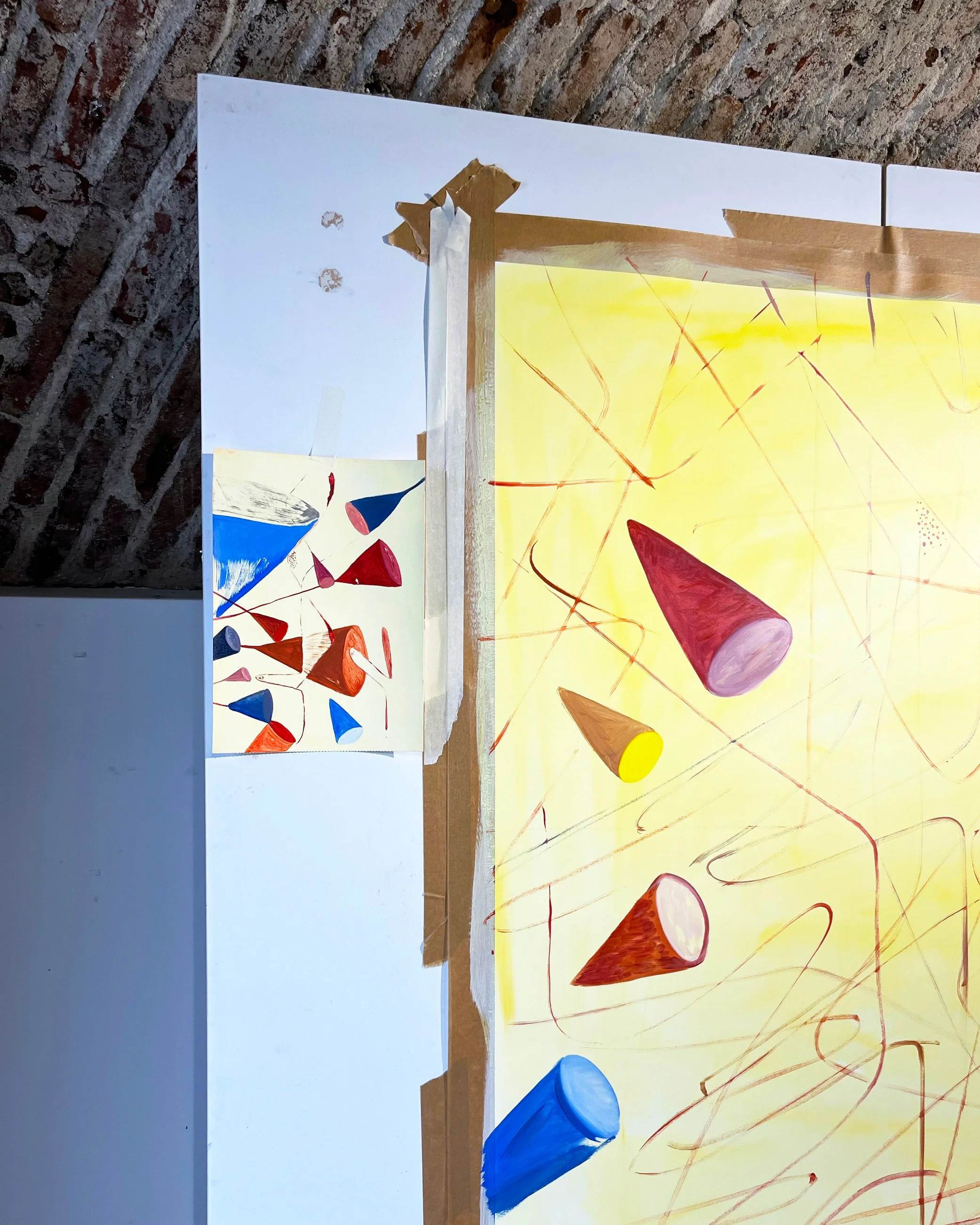
SIMÃO MOTA CARNEIRO move-se entre a pintura e o desenho, num espaço de contaminação entre gestos, matérias e tempos. O seu processo é não-linear e guiado pela intuição com que sente o próprio trabalho. Interessa-lhe o jogo entre o visível e o oculto, e a matéria em transformação.
*
Como descreverias a tua prática? A minha prática situa-se entre a pintura e o desenho, no espaço onde essas duas linguagens se tocam e contaminam. Trabalho nesse espaço de fricção, onde o gesto do desenho traz rapidez e urgência à pintura. O meu trabalho nasce de uma necessidade de fazer, de digerir o mundo, de questionar o olhar. É uma forma de filtrar o que me rodeia e perceber o que o meu radar capta. Parte essencial da prática consiste em criar as condições para que ela possa existir, ter tempo, espaço, silêncio interior. Trabalhar com verdade exige disponibilidade, e essa disponibilidade nem sempre é fácil de alcançar quando tudo à volta te empurra para a pressa, para a produtividade, para o resultado. A prática também é isso: esse malabarismo invisível entre o que se quer fazer e o que se tem que fazer para o poder fazer.
Como caracterizas o teu processo de trabalho? O meu processo não é linear, cada pintura nasce com uma lógica própria e o meu trabalho é ir atrás disso, sem a obrigar a caber num sistema. Às vezes a coisa vem de repente, outras vezes resiste durante semanas ou meses. Umas são construídas, outras são destruídas até que reste qualquer coisa que ainda me diga algo. Muitas vezes pinto contra o que pintei. Às vezes perco o interesse, ou de facto não as consigo resolver e ficam encostadas a um canto. Nem tudo tem salvação nem precisa de ter. O essencial é estar presente e atento enquanto trabalho. A qualidade do olhar e esse equilíbrio entre o que os olhos veem e o que a mão faz, é o que estrutura tudo. Interessa-me não saber para onde estou a ir. É nesse lugar de incerteza que o trabalho está vivo. É preciso tirar a rede de segurança. Acima de tudo, deixo que o trabalho me guie, e eu vou atrás.
Como se equilibram a abstração e a figuração nas tuas obras? Não faço essa distinção no meu trabalho. A pintura, para mim, tem a ver com a matéria, com as manchas de cor, linhas, sobreposições, jogos de esconder e revelar, diferentes diluições, camadas, acumulações, arrastamentos e por aí fora. Há pinturas em que a referência visual está mais visível e onde existe uma ligação mais direta ao mundo observável; mas isso não vem de uma decisão de querer ilustrar. Não estou a pensar nesses termos enquanto pinto, estou atento ao que vai acontecendo. A pintura acontece a uma velocidade diferente da do pensamento (diria até que é a mão que sabe para onde ir, e o ideal é nem me opor a esse movimento.) Existem muitas formas de começar ou desenrolar uma pintura e, mesmo quando a vontade inicial parte de algo figurativo, isso acaba por se diluir no jogo da matéria dentro do retângulo, Há sempre uma supressão do que essa coisa é. A ambiguidade interessa-me por ser esse espaço onde a imagem resiste a ser o que aparenta. No fundo, uma pintura é sempre uma acumulação de gestos e de matéria.
Quais as referências, imagens ou símbolos que vão aparecendo no teu trabalho? As referências aparecem como quem entra por engano, vêm de todo o lado sem hierarquia. Há um repertório que se vai formando com o tempo, como um arquivo interior que se activa de forma intuitiva. Não controlo o que entra, muitas vezes só me apercebo dessas coisas que vão surgindo mais tarde. Interessa-me o que acontece quando coloco dentro do retângulo elementos que não pertencem ao mesmo universo. Isso gera atrito, ressonâncias e deslocamentos. É nesse lugar, onde as coisas se desencaixam, que a pintura nos tira o chão dos olhos.
Por último, em que estás a trabalhar atualmente? Neste momento estou a preparar a minha primeira exposição individual, que será já dia 7 de junho na Plato Porto. Estou muito entusiasmando por mostrar o meu trabalho e tirar as pinturas do atelier. É como se as fosse ver pela primeira vez, de certa maneira. Quando o trabalho sai do atelier (e o vejo noutro espaço) é como se tivessem sido feitas por outro eu. É uma experiência bastante gratificante, ter finalmente a distância para ver, com outros olhos, o que foi feito. Em relação à minha prática de atelier ela está sempre em andamento, estou constantemente a relacionar-me com o mundo. Neste momento, trabalho com escalas maiores, trazendo-me uma maior liberdade na pintura. Há um confronto maior com o retângulo, onde trabalho com todo o corpo. É mais fácil perder o controlo.

FILIPA TOJAL
INTERVIEW NINETEEN
FILIPA TOJAL draws on the contemplation of nature and a fascination with painting to develop an intuitive research of the subtleties of landscape. Moving between observation, studio work, and installation, her practice questions the boundaries of painting, extending a sensitive and contemplative experience of the natural world.
*
How would you describe your practice? I am drawn to the contemplation of nature, but it is the fascination with painting that remains. Starting from an interpretation of the natural world and the landscape — particularly what is subtle within it — I work with transitions, gradations, color, and tonalities, in an intimate practice attentive to rhythm and composition as a whole. In recent years, I have become increasingly interested in what occurs beyond the limits of painting, and, following a slow trajectory, I have also been developing objects and installations that extend a contemplative experience of nature. In this context, the display of my work — the passage from the studio to the exhibition space — is particularly important.
How do you define your work process? I see my process as organized around three fundamental moments: the outdoor experience — walking, observing, moving through the surroundings; the studio time — a dedication to what happens within the limits of painting, through the exploration of materials and supports, gestures and intentions; and the act of placement — the exploration of the relationship between the two-dimensional support and space, and the dialogues and encounters that emerge from it. These are distinct moments, yet closely connected in the way of making, grounded in an intuitive process. All involve attention and care in the handling of the sensorial, developing through layers, by movements of addition and subtraction, where each gesture informs the next.
How do East and West intersect in your work? The years I lived in Japan and my contact with Eastern culture gradually influenced the way I approach painting as a practice. They brought a more attentive relationship with materials — such as paper, linen, and pigments — and a deeper appreciation for the rituals and the rhythms of painting: an attentive, repeated, and silent practice. They also awakened a greater sensitivity to gesture, subtlety, emptiness, and silence. At the same time, they opened a way of thinking about painting in its expanded dimension — its horizontality, and its relationship to the ground and to space. In the Western approach, I recognize in my process a certain pragmatism, which leads me to embrace chance and improvisation as part of the making, a more direct way of resolving each work. These two approaches coexist in my practice, not always visible, yet continuously informing different dimensions of the work.
What references appear over time in your works? My references grow out of direct experiences — a sensorial contact with space, with materials, and with the everyday. I am drawn to small architectural compositions and unexpected encounters of color, texture, and rhythm, which often reappear transformed in my work. In parallel, there is a close attention to the artisanal process and to forms of making that are linked to the passage of time, always near to the body and the gesture. Among the artists I feel close to, even if from a distance, are Agnes Martin, Etel Adnan, Suzan Frecon, Thea Djordjadze, and Veronica Ryan, whose attention to subtlety continues to resonate with me. Living in Japan brought me a more direct approach to making, especially through the contact with the work of Professor Hiroshi Sugito. More broadly, artists like Isamu Noguchi and Kishio Suga remain fundamental references in the way I think about the relationship between object, space, and emptiness. There also remains the silent influence of the visual memory of Japanese folding screens from the sixteenth to the eighteenth centuries — such as Cypress Trees by Kano Eitoku (sixteenth and Cranes, Pines, and Bamboo by Ogata Korin.
Finally, what are you currently working on? I am currently concluding the first year of my PhD in Fine Arts at FBAUP, where I am developing a research project based on the dialogue between my artistic practice and an archive in construction, along with a particularly resonant collection — the Francisco Laranjo Archive. The relationship with gestures of archiving, cataloguing, organizing, and arranging has become a natural extension of the attention I already dedicate to everyday compositions and processes. During the summer, I will take part in the No Entulho residency and present my work at the Escola das Artes da Universidade Autónoma de Lisboa. I am also preparing a solo exhibition at Gallery Crossing, in Japan.


FILIPA TOJAL parte da contemplação da natureza e do fascínio pela pintura para desenvolver uma investigação intuitiva das subtilezas da paisagem. Entre a observação, o trabalho de atelier e a instalação, a sua prática questiona os limites da pintura, prolongando uma experiência sensível e contemplativa do natural.
*
Como descreverias a tua prática? Interessa-me a contemplação da natureza, mas é o fascínio pela pintura que permanece. A partir da interpretação do natural e da paisagem — particularmente do que nela é subtil —, trabalho com transições, gradações, cor e tonalidades, numa prática íntima e atenta ao ritmo e à composição como um todo. Nos últimos anos, tenho-me interessado naquilo que acontece ou transborda os limites da pintura para o espaço e, numa trajetória lenta, tenho vindo a desenvolver também objetos e instalações que prolongam uma experiência contemplativa da natureza. Por isso mesmo, a disposição do meu trabalho — a passagem do atelier para o momento expositivo — assume uma importância particular.
Como caracterizas o teu processo de trabalho? Considero que o meu processo se organiza em três momentos fundamentais: o movimento exterior — caminhar, observar, percorrer o redor; o tempo de atelier — uma dedicação ao que se encontra dentro dos limites da pintura, à exploração das matérias, suportes, gestos e intenções; e o momento de instalação — o explorar da relação do suporte bidimensional com o espaço, os diálogos e encontros que daí resultam. São momentos distintos, mas próximos no modo de fazer, assentes num processo intuitivo. Todos envolvem atenção e cuidado no trato do sensível, desenvolvendo-se por camadas, por movimentos de adição e subtração, em que cada gesto informa o seguinte.
Como se cruzam o Oriente e Ocidente no teu trabalho? Os anos que vivi no Japão e o contacto com a cultura oriental influenciaram gradualmente o modo como me aproximo do fazer. Trouxeram uma atenção mais cuidada aos materiais — como o papel, o linho e os pigmentos — e uma maior apreciação pelos rituais e pelos tempos da prática da pintura: um fazer atento, repetido e silencioso. Despertaram também um olhar mais sensível ao gesto, à subtileza, ao lugar do vazio e ao silêncio. Houve, igualmente, um pensar da pintura na sua dimensão expandida, na horizontalidade, em relação com o chão e o espaço. Do lado ocidental, reconheço no meu processo um certo pragmatismo, que me leva a aceitar o acaso e a improvisação como parte do fazer, uma forma mais direta de resolver cada trabalho. Essas duas abordagens coexistem na minha prática, nem sempre de forma evidente, mas informando diferentes dimensões do trabalho.
Quais as referências que vão aparecendo ao longo dos tempos nas tuas obras? As minhas referências surgem sobretudo de experiências diretas — de um contacto sensorial com o espaço, com os materiais e com o quotidiano. Interesso-me por pequenas composições arquitetónicas e encontros inesperados de cor, textura e ritmo, que muitas vezes reaparecem transformados no trabalho. Paralelamente, há uma atenção ao fazer artesanal e a processos ligados à passagem do tempo, próximos do corpo e do gesto. No campo artístico, acompanham-me de forma mais distante nomes como Agnes Martin, Etel Adnan, Suzan Frecon, Thea Djordjadze e Veronica Ryan, cuja atenção à subtileza continuo a reconhecer como próxima. A vivência no Japão trouxe uma aproximação mais direta ao fazer, em especial através do contacto com o trabalho do professor Hiroshi Sugito. De forma mais ampla, artistas como Isamu Noguchi e Kishio Suga continuam a ser referências fundamentais na relação entre objeto, espaço e vazio. Permanece também a influência silenciosa da memória visual dos biombos japoneses, produzidos entre os séculos XVI e XVIII — como Cypress Trees, de Kano Eitoku, e Cranes, Pines, and Bamboo, de Ogata Korin.
Por último, em que estás a trabalhar atualmente? Atualmente, encontro-me na fase final do primeiro ano do Doutoramento em Artes Plásticas na FBAUP, onde desenvolvo uma investigação a partir da convivência da minha prática artística com um arquivo em construção e com um acervo artístico particularmente ressonante, o do Arquivo Francisco Laranjo. A relação com gestos de arquivar, catalogar, organizar e dispor tem-se tornado uma extensão natural da atenção que já dedico às composições e processos do quotidiano. Durante o verão, participarei na residência No Entulho e apresentarei o meu trabalho na Escola das Artes da Universidade Autónoma de Lisboa. Estou também a preparar uma exposição individual na Gallery Crossing, no Japão.

PEDRO GRAMAXO
INTERVIEW EIGHTEEN
PEDRO GRAMAXO is a multidisciplinary contemporary artist who situates his practice in the context of constructive art, installation and photography, analyzing and deepening the relationship between human beings and space, time, memory and the different states of perception.
*
How would you describe your practice? I tend to believe that concepts/terms such as "Land-based," "self-aware," "contrivance," and others derived from the domains of altered perceptions and constructive artificial developments are the most compatible with my practice. In media such as installation, photography, video, and drawing, the complementation of material narratives and investigations with immaterial ones grows to explore the permanence of artificial development in natural contexts.
How do you define your work process? I can characterize my process as "architectural" because of its genesis of technical-conceptual development, its scale, and sociocultural dynamics. For me, the procedural explanation must be a constructive act, adding all inherent elements and contexts (spatial, temporal, perceptive). Among the various phases, drawing, painting, cutting, 2D and 3D technical drawing, and samples are the tools I use most.
How do visual arts, architecture and gastronomy intersect in your work? Considering them as artistic manifestations, it is interesting to think (again) about their approach when constructing processes and experiences. Physical bodily expertise is essential in all its complexities when I explore perceptual deviations and other phenomenological issues. Thus, "site-based" and "Land-based" combine many specific elements that can define a work. Working on the landscape means working on its resources and combining visual, architectural, and gastronomic constructive gestures. The poetics also crosses its reverse side, working the timelines of a 2-minute gastronomic project to a 2-year installation project and the spatial conception of 2 mm of seed to 20 m of cement and gravel.
What references appear over time in your works? I mix everything. Sometimes, it's hard to understand what takes root. Since the Social Modernism of the second half of the 20th century, XX, to Mono-ha, Francis Mallmann, and 1200 Mics, it has been the discovery of new cultures, new construction techniques, technologies, cinema, music, gastronomy, and all its satellites.
Finally, what are you currently working on? I am currently "dissecting" the various tectonic layers of my work and their respective artificialities, rethinking scale and manual work. I would like to create more significant works and a more intricate relationship between art and architecture.


PEDRO GRAMAXO é um artista contemporâneo multidisciplinar que situa a sua prática no contexto da arte construtiva, instalação e fotografia, analisando e aprofundando a relação do ser humano com o espaço, o tempo, a memória e os vários estados de percepção.
*
Como descreverias a tua prática? Tendo a crer que os conceitos/termos como “Land-based”, “self-aware”, “contrivance” e demais derivantes dos domínios das perceções alteradas e desenvolvimentos artificiais construtivos sejam os mais compatíveis com a minha prática. A complementação de narrativas e investigações materiais com imateriais crescem em media como a instalação, fotografia, vídeo e desenho para explorar a permanência do desenvolvimento artificial em contextos naturais.
Como caracterizas o teu processo de trabalho? Posso caracterizar o meu processo como “arquitetónico”, tanto pela sua génese de desenvolvimento técnico-conceptual como pela sua escala e dinâmicas socioculturais. Para mim, a explanação processual, deve ser um ato construtivo. Agregando todos os elementos inerentes e contextos (espaciais, temporais, percetivos). De entre variadas fases, o desenho, a pintura, o recorte, o desenho técnico 2D e 3D, e as amostras são as ferramentas que mais utilizo.
De que forma se cruzam as artes visuais, arquitectura e gastronomia no teu trabalho? Considerando-as como manifestações artísticas, é interessante pensar (novamente) na sua aproximação aquando da construção de processo e experiência. Quando exploro desvios percetivos e demais questões fenomenológicas, a experiência física corporal é essencial em todas as suas complexidades, assim, o “site-based” e o “Land-based” reúnem um grande número de elementos específicos que podem definir uma obra. Trabalhar a paisagem, é trabalhar os seus recursos, e cruzar gestos construtivos visuais, arquitetónicos, gastronómicos. A poética também atravessa o seu avesso, trabalhando as linhas temporais de um projeto gastronómico de 2 min a um projeto de instalação de 2 anos, e a conceção espacial de 2 mm de semente a 20 m de cimento e brita.
Quais as referências que vão aparecendo ao longo dos tempos nas tuas obras? Bebo de tudo. Por vezes difícil perceber o que cria raízes. Desde o Social Modernismo da segunda metade do séc. XX, ao Mono-ha, Francis Mallmann e 1200 Mics. Essencialmente a descoberta de novas culturas, novas técnicas construtivas, tecnologias, cinema, música, e claro... a gastronomia e todos os seus satélites.
Por último, em que estás a trabalhar atualmente? Estou neste momento a “dissecar” as várias camadas tectónicas do meu trabalho e respetivas artificialidades, repensar a escala e a manualidade. Gostava de conseguir concretizar obras de maior dimensão e uma relação mais intricada entre arte e arquitetura.

LUÍSA SERÔDIO
INTERVIEW SEVENTEEN
LUÍSA SERÔDIO describes herself succinctly as a "decorator, restorer, and collector of objects." Her work begins with the collection of objects and pieces of sets that she has yet to assemble. She lives in Montemor-o-Novo, where she materializes beings, freeing them from the objects that imprison them and returning them to the world.
*
How would you describe your practice? Assemblies, without a doubt. Or sculptures? Or 3D collages (hahaha)? Buildings? Let's say I discover beings, free creatures trapped in objects. I materialize emotions, the grotesque, the rogue, joy, curiosity, astonishment, poetry, and the human, in short. They are anachronistic characters who have inhabited us since we were human, that is, survivors of ancient times.
How do you define your work process? I come from the restoration and decoration industry. I like to accumulate objects and possibilities. Trash doesn't exist; everything is in a state of flux and transformation. I start with any object (that I find beautiful, such as a rusty can or an alabaster cup) and wait for it to speak to me. I'm patient! I listen and wait. I look around, leave the scene, and come back unexpectedly (to catch him red-handed?). And I start again. Suddenly, the being appears to me. It's an epiphany! Sometimes I feel angry, but then we reorganize and reassemble into new forms, and we make peace.
What references appear/are reflected over time in your pieces? Anthropology, ethnography, popular, folkloric, tribal art. Popular bestiaries, puppets, fantastic tales, carnivals, clowns, demons, the ornaments of Gothic cathedrals, Bosch, Goya, etc. Oh, and the kitsch! Raw art, contemporary dance, the new circus.
What is the most unusual object that gave rise to a piece? Everything seems unusual, yet at the same time, nothing feels out of the ordinary. Beings inhabit all objects. Just let them leave. Anything will do, from a sheep's skull to a metronome. I'm always amazed at what comes up.
Finally, what are you currently working on? The director of the Montemor-o-Novo Puppet Festival invited me to occupy the foyer of the Curvo Semedo Theater in May. The festival's theme reflects the current global situation we face. I will lead a joyful uprising against all forms of repression and intolerance because joy does not surrender. The parade is called "They Shall Not Pass!"


LUÍSA SERÔDIO descreve-se muito resumidamente como “Decoradora, restauradora, respigadora de objectos”. O seu trabalho parte da acumulação de objetos, de peças de conjuntos que ainda irá juntar. Vive em Montemor-o-Novo, onde materializa seres, libertando-os dos objetos que os prendem, e devolvendo-os ao mundo.
*
Como descreverias a tua prática? Assemblagens, sem dúvida. Ou esculturas? Ou colagens 3D (ahahah)? Construções? Digamos que descubro seres, liberto criaturas presas em objetos. Materializo emoções, o grotesco, o pícaro, a alegria, a curiosidade, o espanto, a poesia, o humano enfim. São personagens anacrónicas, que nos povoam desde que somos gente, ou seja, sobreviventes de tempos antigos.
Como caracterizas o teu processo de trabalho? Venho do restauro, da decoração. Gosto de acumular objetos e possibilidades. Lixo não existe, tudo é um devir. Parto de um objeto qualquer (que eu ache bonito, pode ser uma lata ferrugenta ou uma taça de alabastro) e espero que ele fale comigo. Sou paciente! Escuto e espero. Olho em volta, saio de cena, volto inesperadamente (para o apanhar em flagrante?). E recomeço. De repente o ser está ali, a olhar para mim. É uma epifania! Mas às vezes zango-me. Então eles reorganizam-se e refazem-se (reassemblam-se) em novas formas. E fazemos as pazes.
Quais as referências que vão aparecendo/reflectindo ao longo dos tempos nas tuas peças? Antropologia, etnografia – arte popular, folclórica, tribal. Os bestiários populares, as marionetas, os contos fantásticos, os carnavais, palhaços, demónios, os ornamentos das catedrais góticas, Bosch, Goya, etc. ah e o kitsch! A arte bruta, a dança contemporânea, o novo circo.
Qual o objeto mais inusitado que deu origem a uma peça? Tudo é inusitado e nada é inusitado. Os seres habitam todos os objetos. É só deixar que saiam. Qualquer coisa serve, desde uma caveira de ovelha a um metrónomo. Fico sempre espantada com o que surge.
Por último, em que estás a trabalhar atualmente? O diretor do Festival de Marionetas de Montemor-o-Novo convidou-me para ocupar o foyer do teatro Curvo Semedo em Maio. O festival tem um tema que tem a ver com o momento que estamos a viver a nível mundial. Vou apresentar um "desfile" ou levantamento popular contra todas as formas de repressão e intolerância, usando a alegria como resistência, porque a alegria não se rende. O desfile chama-se "Não Passarão!".

TIAGO ROCHA COSTA
INTERVIEW SIXTEEN
TIAGO ROCHA COSTA clearly situates his visual universe in three-dimensionality, currently marked by “fossilized artifacts.” Nature is a central point in his work, exploring its limits and interconnections with a critical and expressive eye.
*
How would you describe your practice? My practice lies somewhere between painting, sculpture, and installation, so I see myself essentially as a visual artist. I have never felt that disciplinary issues have influenced the direction of my work.; what truly interests me is responding to an authorial universe that seems to assert itself. Over time, this universe has manifested itself through different supports and ways of doing things, which are, in part, determined by the specificity of each project. Currently, this location is filled with three-dimensional objects that look like "fossilized artifacts."
I believe that I am driven by a curiosity similar to that of some scientists, as the themes I pursue through my work are things that interest me deeply and about which I would like to know everything. But since that is not possible, what I do is an artistical approach to the issues that concern me and that I would not be able to resolve in any other way. In recent years, I have been interested in methods of representing and classifying nature (as they appear throughout the history of natural sciences), in the possibilities of coexistence between species, and in the processes of erosion and sedimentation that shape our perception of time.
How do you define your work process? In my work, there is a reciprocity between previous ideas and the coincidences that arise in the studio or outside it. Natural and artificial materials are intertwined, as I believe each possesses important properties and connotations for the discourse of the work, particularly when addressing the concept of nature or post-nature. The Synthetic Sealife series (2022) originated from an accidental chemical reaction. I had left a fishing bait resting on a plate made of extruded polystyrene, and after several days, I noticed that the rubber object was corroding the surface beneath it. I prefer to work in series, with identical objects that follow the same principles, but which, as the work progresses, become more individual. Some become larger, narrower, darker, more colorful, or more complex; others present deformations that move them away from their point of origin. Either way, they become something they weren't in the beginning, and that's something I don't try to fully control. It is an almost taxonomic logic, typical of the classification systems that interests me so much. As in a species in which all individuals are the same, but unique.
What references appear/reflect throughout time in your works? I often return to the same themes, primarily drawn from biology, paleontology, and archaeology, as I connect with their subjects and processes. In two recent series – "Conceito Tropical" (2024) and "Ichthyosaurus" (2024) – I worked with images I found in natural history museum archives. The former are of exotic birds preserved in drawers; the latter are fossils of marine reptiles, displayed in showcases. Once, I started a collection of flykillers. I became interested in the insects depicted on the plastic grids and the pop colors of this crushing tool. A few months later, I found illustrations of a giant prehistoric dragonfly and wanted to imagine what it would be like if we shared the same space and time. That reminded me of how much I loved insects when I was younger, their negative connotation in both cities and the countryside, and the scale problem they present – as the very small and the very large don’t always make sense together. I decided to bring these concerns into the studio and give them form. First came the drawing, then the structure, and finally the green mortar that turned into rock. From this came "Meganeura" (2023).
In what ways is nature explored in your works? Nature is a theme that has always been present in my life, and I recognize that it cannot be separated from culture. This realization has led me to explore the connections and boundaries between the two. My work inherently includes a human dimension, serving as a layer that mediates our experience with nature while embracing some artificiality in the processes involved. This perspective prompts me to question anthropocentric viewpoints and reflect on our fragility as a species. On one hand, I view nature as a concept in crisis that is unlikely to meet the expectations set by its representations in the past. On the other hand, I continue to see it as a powerful force that, despite our efforts to dominate and exploit it, has the potential to reinvent itself beyond human temporality. Perhaps that's why I resonate with the materiality of fossils and ruins; their remnants remind me of transience and allow me to envision multiple pasts and futures. Although some of my works can be interpreted from an environmentalist perspective, I approach them without any moralistic intent. I am resistant to telling the viewer how they should feel, act, or position themselves regarding a particular theme. Likewise, despite the scientific references that accompany my work—references I enjoy discussing—I don’t consider it educational. My work does not aim to produce useful knowledge or explain external events. Providing context about a specific species or phenomenon I wish to represent can be helpful, but if my work sparks interpretations that stray from my initial intentions, I see that as a positive outcome.
Finally, what are you currently working on? In the coming months, I will focus on writing my PhD thesis, which relates to some of the issues we have discussed earlier. Alongside the practical component, I am researching, from a theoretical perspective, how visual arts, scientific knowledge, and fiction can (or cannot) contribute to reconfiguring our relationships with the natural world. This year, I have two collaborative projects planned that I am very excited about. One of these projects, called Hedone, is an initiative by Plato that challenges me to think about the concept of hedonism in the context of my work, linking it to the issue of capital. The other project, Simbiopolis, is an art and ornithology initiative I am coordinating, in which I have invited four artists to join me in reflecting on the cultural meaning of exotic birds living freely in urban environments. This project focuses on the case of the rose-ringed parakeets in Lisbon. Both projects will culminate in exhibitions at the end of the year.


TIAGO ROCHA COSTA situa claramente o seu universo visual na tridimensionalidade, marcada atualmente pelos “artefactos fossilizados”. A natureza assume-se com um ponto central do seu trabalho, explorando com um olhar crítico e plástico os seus limites e entrelaçamentos.
*
Como descreverias a tua prática? A minha prática situa-se algures entre a pintura, a escultura e a instalação, por isso vejo-me essencialmente como artista visual. Nunca senti que o rumo do meu trabalho fosse determinado por questões de ordem disciplinar, até porque aquilo que realmente me interessa é conseguir responder a um universo autoral que parece impor-se por si mesmo. Ao longo do tempo, esse universo tem-se manifestado através de diferentes suportes e modos de fazer, que são, em parte, determinados pela especificidade de cada projeto. Atualmente esse lugar é ocupado pela tridimensionalidade, com os «artefactos fossilizados». Acredito que sou movido por uma curiosidade semelhante à de alguns cientistas, pois os temas que persigo através do meu trabalho são coisas que me interessam profundamente e sobre as quais gostaria de saber tudo. Mas como isso não é possível, o que faço é uma aproximação plástica às questões que me inquietam e que não conseguiria resolver de outra forma. Nos últimos anos tenho-me interessado por métodos de representação e classificação da natureza (conforme aparecem ao longo da história das ciências naturais), pelas possibilidades de coexistência entre espécies, e também pelos processos de erosão e sedimentação que moldam a nossa perceção do tempo.
Como caracterizas o teu processo de trabalho? No meu trabalho existe uma reciprocidade entre ideias prévias, e os acasos que surgem no atelier ou fora dele. Cruzam-se materiais naturais e artificiais, porque acredito que cada um tem propriedades e conotações importantes para o discurso da obra, sobretudo quando se aborda a ideia de natureza ou de pós-natureza. A série Synthetic Sealife (2022), por exemplo, nasceu de uma reação química descoberta de forma acidental, quando deixei um isco de pesca pousado sobre uma placa de poliestireno extrudido e, passado vários dias, reparei que aquele objeto de borracha estava a corroer o suporte. Tenho uma preferência em trabalhar por séries, com objetos idênticos que obedecem aos mesmos princípios, mas que, à medida que o trabalho avança, se individualizam. Alguns tonam-se maiores, mais estreitos, escuros, coloridos ou complexos; outros apresentam deformações que os afastam do ponto de origem. De qualquer modo, tornam-se uma coisa que não eram no princípio, e isso é algo que não procuro controlar na totalidade. É uma lógica quase taxonómica, própria dos sistemas de classificação que tanto me interessam. Como numa espécie em que todos os indivíduos são aparentemente iguais, mas únicos.
Quais as referências que vão aparecendo/reflectindo ao longo dos tempos nas tuas obras? O meu universo de referências é cíclico e tenho a sensação de que regresso sempre aos mesmos temas. A maior parte provêm de áreas científicas como a biologia, a paleontologia ou a arqueologia, porque me identifico com os seus objetos de estudo e processos. Em duas séries recentes – Conceito Tropical (2024) e Ichthyosaurus (2024) – trabalhei com imagens que encontrei em arquivos de museus de história natural. As primeiras são de aves exóticas conservadas em gavetas; as segundas de fósseis de répteis marinhos, emoldurados em vitrinas. Uma vez, comecei uma coleção de mata-moscas. Interessei-me pelos insetos desenhados nas grelhas de plástico e pelo colorido pop desta arma de esmagamento. Alguns meses depois encontrei ilustrações de uma libélula pré-histórica gigante e quis imaginar como seria se partilhássemos o mesmo espaço e tempo. Isso lembrou-me do quanto gostava de insetos quando era mais novo, da sua conotação negativa nas cidades e no campo, e do problema de escala com que nos confrontam – pois o muito-pequeno e o muito-grande nem sempre se compreendem. Decidi levar estas inquietações para o atelier e dar-lhes corpo. Primeiro veio o desenho, depois a estrutura e, por último, a argamassa verde que se transformou em rocha. Daqui nasceu Meganeura(2023).
De que forma(s) é explorada a natureza nas tuas obras? A natureza é um tema que sempre me acompanhou e, por reconhecer que não é possível separá-la da cultura, tenho-me interessado por explorar os seus limites e entrelaçamentos. No meu trabalho está implícita uma dimensão humana, como uma camada que medeia a nossa experiência com a natureza e que abraça até uma certa artificialidade dos processos. Isso leva-me a questionar pontos de vista antropocêntricos e a pensar na nossa fragilidade enquanto espécie. Por um lado, vejo a natureza como um conceito em crise que dificilmente poderá corresponder às expectativas criadas pelas suas representações do passado. Por outro, continuo a vê-la como uma força que, apesar dos nossos esforços para a dominar e instrumentalizar, tem a capacidade de se reinventar muito para além da temporalidade humana. Talvez seja por isso que me identifico com a materialidade dos fósseis e das ruinas – porque os seus fragmentos me lembram desta transitoriedade e me permitem imaginar múltiplos passados e futuros. Apesar de algumas das minhas obras poderem ser interpretadas de acordo com uma perspetiva ambientalista, considero-as desprovidas de uma atitude moralista, pois tenho alguma resistência em dizer ao espectador como se deve sentir, comportar ou posicionar perante um determinado tema. Do mesmo modo, apesar das referências científicas que o acompanham, e sobre as quais gosto de falar sempre que tenho oportunidade, penso que o meu trabalho não é didático, pois não produz conhecimento útil nem tenta explicar acontecimentos que lhe são exteriores. Por vezes, pode ser útil fornecer algum contexto sobre uma determinada espécie ou fenómeno que quis representar, mas se o meu trabalho despertar outras leituras, ainda que longe das minhas intenções iniciais, isso será um bom sinal.
Por último, em que estás a trabalhar atualmente? Nos próximos meses vou estar focado na escrita da minha tese de doutoramento, que se relaciona com algumas das questões de que falámos anteriormente, pois além da componente prática, estou a investigar, de um ponto de vista teórico, sobre a forma como as artes visuais, o conhecimento científico e a ficção, podem (ou não) contribuir para reconfigurar as nossas relações com o mundo natural. Para este ano tenho prevista a minha participação em dois projetos colaborativos que me entusiasmam muito. Um deles – Hedone – é uma iniciativa da Plato, que me desafiou a pensar o conceito de hedonismo no contexto do meu trabalho, ligando-o ainda à questão do capital. O outro – Simbiopolis – é um projeto de arte e ornitologia que estou a coordenador e para o qual convidei quatro artistas para, em conjunto, refletirmos sobre o significado cultural das aves exóticas que vivem em liberdade nas cidades. Isto a partir do caso dos periquitos-de-colar, em Lisboa. Ambos os projetos terão momentos expositivos no final do ano.
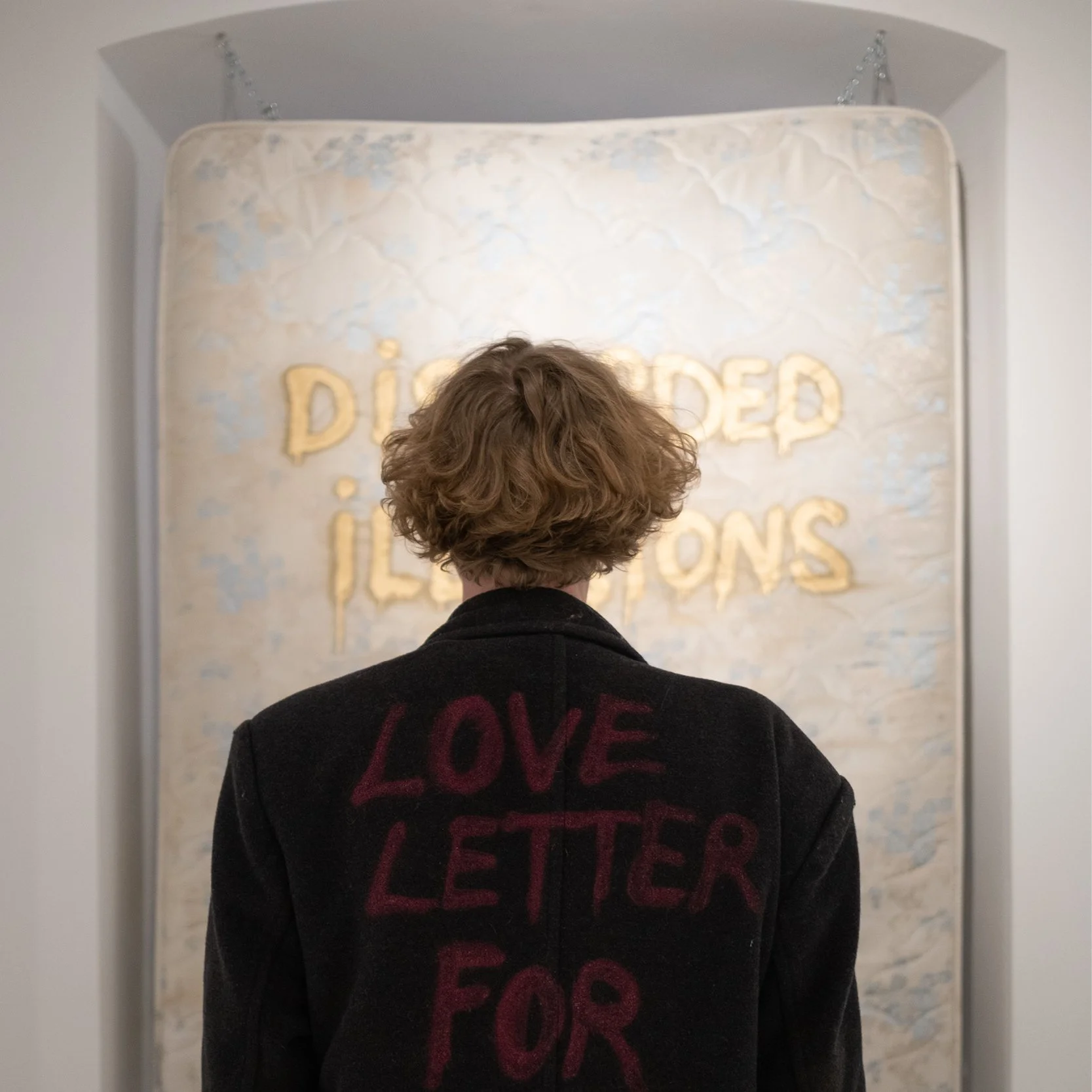
DEAR ANUSHKA
INTERVIEW FIFTEEN
Dear Anushka uses public space as a stage, where she intervenes with fragmented notes that she leaves behind. Each discarded mattress becomes a receptacle for a message that reflects onto the passerby (spectator). Through irony and humor, sometimes tragic, each object resulting from her practice serves as a critique of the present, this contemporary era of the ‘meme’.
*
How would you describe your practice? My project with abandoned mattresses is about bringing attention to what’s forgotten or overlooked, inspired by the world around me. Once deeply personal and intimate, these mattresses are left in public spaces, and I feel the need to give them a voice—transforming them into canvases for poetry and reflection. My ideas come from everyday life: emotions, music, art, and books. I often write down thoughts or phrases so I don’t lose them. When the moment feels right, and I don’t have a spontaneous phrase in mind, I use those notes to tag a mattress. With my words, I hope to start a conversation—between the mattress, its story, and the people who see it on the street.
How do you define your work process? I work pretty intuitively and try not to force myself into creating something ‘perfect.’ Creativity flows better when my mind is open. There’s this adrenaline rush when I come across a mattress while I’m out, knowing I must act on the spot. Since I don’t keep mattresses in a studio, it’s always a quick decision—tag it or leave it. Most of my work happens in the moment, which keeps it alive and exciting. I pay attention to the condition and surroundings of the mattress when thinking about what to write. It’s important to me to give the mattress the right voice, not just something random. Afterward, I take photos and videos, documenting its story. Honestly, I think I know mattress patterns and stains better than anyone except maybe the garbage collectors. I almost always carry a spray can, just in case. But sometimes I leave it behind and tell myself, 'Today’s a break. No work.' The funny thing is, even on those “off” days, I still find myself scanning the streets for mattresses. My city walks have basically turned into mattress hunts, so yeah, I guess I’m always working, haha.
What does the mattress symbolize? For me, a mattress is so much more than just an object to sleep on—it’s like a stage for some of life’s most intimate and transformative moments. We’re born on them, we dream on them, we love on them, we cry on them, and sometimes we even die on them. When a mattress gets abandoned, it’s still holding all those layers of memories, emotions, and hopes. To me it’s a powerful symbol of where the personal meets the public, and where something private becomes something discarded.
If you combine all the poems from all the mattresses you ever made into one book, what would be the plot? I’ve always dreamed of writing a book of short stories, and gathering all the poems from the mattresses could make that dream come true—a poetic collection. It wouldn’t have a clear beginning, middle, or end. Instead, it would be like a kaleidoscope of emotions, showing how beautifully messy life can be. The “plot” would explore life’s little truths, moments of vulnerability, and the raw beauty found in unexpected places. A collection of human experiences, captured on worn-out mattresses, ready to be reimagined into something new.
Finally, what are you currently working on? I hope 2025 brings just as much chaos and beauty as 2024 did! I’d love to take my work to the next level. I imagine showcasing my mattress photos in the size of an actual mattress. I’m also eager to get more creative with preserving mattresses as objects that complete a full life cycle: starting as a bed in someone’s home, then abandoned on the street, and finally finding a new home—not in a bedroom, but as art on a wall. And of course, I’m dreaming of traveling to new places, exhibiting in different countries, and seeing how my work resonates with people from all over. The world is full of mattresses waiting to be tagged, and I can’t wait to discover what’s next.


A Dear Anushka utiliza o espaço público como um palco, onde intervém com anotações fragmentadas que vai abandonando. Cada colchão descartado é receptáculo de uma mensagem que se reflecte no transeunte (espectador). Através da ironia e do humor, por vezes trágico, cada objecto que resulta da sua prática é uma crítica ao agora, a esta era contemporânea do ‘meme’.
*
Como descreverias a tua prática? O meu projeto com colchões abandonados tem como objectivo chamar a atenção para o que é esquecido ou negligenciado, inspirado no mundo à minha volta. Esses colchões, que já foram profundamente pessoais e íntimos, são deixados no espaço público. Sinto a necessidade de lhes dar uma voz, transformando-os em suportes para a minha poesia e reflexão. As minhas ideias vêm do quotidiano: emoções, música, arte e livros. Muitas vezes escrevo pensamentos ou frases para não as esquecer. Quando o momento parece certo, e não tenho uma frase em mente, uso essas notas para deixar um “tag”num colchão. Com essas palavras, espero iniciar uma conversa — entre o colchão e a sua história, e as pessoas que o encontram na rua.
Como caracterizas o teu processo de trabalho? Trabalho de forma bastante intuitiva e evito forçar-me a criar algo "perfeito". A criatividade flui melhor quando a mente está aberta. Sinto uma adrenalina quando me deparo com um colchão durante os meus passeios, sabendo que preciso agir imediatamente. Como não guardo colchões num estúdio, é sempre uma decisão rápida—taggear ou deixá-lo. A maior parte do meu trabalho acontece no momento, o que mantém o processo vivo e emocionante. Presto atenção ao estado do colchão e ao seu contexto quando penso no que escrever. Para mim, é importante dar ao colchão uma voz adequada, e não apenas algo aleatório. Depois, tiro fotos e gravo vídeos e sinto que estou a documentar a sua história. Para ser honesta, acho que conheço os padrões e manchas de colchões melhor do que qualquer pessoa, talvez apenas os lixeiros me superem. Quase sempre carrego uma lata de spray comigo, por precaução. Mas às vezes decido deixá-la em casa e digo a mim mesma: "Hoje é um dia de folga. Nada de trabalho." Engraçado é que, mesmo nesses dias de “descanso”, ainda me vejo a vasculhar as ruas à procura de colchões. Os meus passeios pela cidade transformaram-se basicamente em caças a colchões. Então, sim, acho que estou sempre a trabalhar, haha.
O que simboliza o colchão? Para mim, um colchão é muito mais do que um objeto para dormir, é como um palco para alguns dos momentos mais íntimos e transformadores da vida. Nascemos sobre eles, sonhamos sobre eles, amamos sobre eles, choramos sobre eles e, por vezes, até morremos sobre eles. Quando um colchão é abandonado, ainda guarda todas essas camadas de memórias, emoções e esperanças. Para mim, simboliza o encontro entre o pessoal e o público, entre o íntimo e o descartado.
Se juntasses os poemas de todos os colchões num livro, qual seria o enredo? Sempre sonhei em escrever um livro de contos, e juntar todos os poemas dos colchões poderia realizar esse sonho— uma coleção poética. Não teria um começo, meio ou fim. Seria mais como um caleidoscópio de emoções, mostrando como a vida pode ser confusa e bela ao mesmo tempo. O “enredo” exploraria as pequenas verdades da vida, momentos de vulnerabilidade e a beleza crua encontrada nos lugares mais inesperados. Uma coleção de experiências humanas, capturadas em colchões desgastados, prontas para serem reimaginadas de uma forma nova.
Por último, em que estás a trabalhar atualmente? Espero que 2025 traga tanto caos e beleza quanto 2024 trouxe! Gostaria de levar o meu trabalho para um próximo nível. Imagino as fotografias dos meus colchões ampliadas ao tamanho de um colchão real. Também estou entusiasmada por explorar novas formas de preservação dos colchões. Como objetos que completam um ciclo de vida: começam como camas em casas, são abandonados na rua e, por fim, encontrariam um novo lar. Não num quarto, mas como obra exposta numa parede.
E, claro, sonho em viajar para novos lugares, expor em diferentes países e ver como o meu trabalho ressoa com pessoas de todo o mundo. O mundo está cheio de colchões à espera de serem taggeados, e mal posso esperar para descobrir o que vem a seguir.

EDUARDO ANTONIO
INTERVIEW FOURTEEN
Eduardo Antonio reflects on multiple issues in his paintings, drawing from the moments and places he has experienced, creating a narrative that unfolds across his various works. Without worry or haste to reach a specific destination, his art flows in a dialogue between the memory of the past and the unknown yet to come.
*
How would you describe your practice in painting? My practice in painting comes from a very personal and intimate place. It is a space where I can pause and reflect on life and other issues that matter to me. I say it is personal because, besides drawing many references from my past, such as places I have lived and old family photographs, there is always a synchronicity between what I paint and the moment I am living. In this personal aspect, I realize that some dialogues with the history of painting have emerged in my work, which I see as a part of my life. Due to my distance from the landscapes and references I paint — primarily related to Brazil — the history of painting has significantly influenced the imagery I pursue in my work.
How do you define your work process? My painting process is very much linked to my involvement with the practice. My work mainly develops within the studio. I typically begin with an idea, create drawings, and explore my direction throughout the process without defining a specific path or goal. I believe that painting carries something mysterious and inexplicable that I try to preserve, which only manifests in the act of painting. Often, one painting gives rise to others, as if one idea leads me to think of new possibilities. In this process, relationships emerge that happen only between the images, in a thought that seems more connected to the unconscious and the dreamlike, something I do not try to explain or control. The selection of materials is highly important to me. I am constantly experimenting and researching different techniques, paints, and supports. These discoveries and experiments somewhat diminish my control over the painting, allowing me to integrate accidents into the process. It’s as if I include the unknown and leave a certain type of mystery present in everything I do.
Is there a narrative that interconnects the various paintings over the past years? Typically, the images I work with end up manifesting through narratives. I believe this may stem from my background in cinema before pursuing painting. What connects all these ideas is my own life; I don't worry about following a specific line or theme. Sometimes, one idea or painting evolves into others that engage in a dialogue on the same theme. I have worked on a series of paintings focused on themes such as theater, circus, or the idea of constructions and houses. I avoid limiting my actions to a specific theme, allowing ideas to emerge naturally. Even so, I perceive a journey and some elements that repeat in my work. It is almost always possible to create relationships between the paintings. What connects them may be my style of painting or my perspective on the art of painting. This lack of concern for a specific theme or narrative ultimately links the works together.
In what way(s) are the different landscape concepts explored in your works? Landscape has always been a significant element in my work. When I began painting, I lived in Florianópolis, Brazil—a city where nature is essential. This sparked my interest. Florianópolis is abundant in beaches, lagoons, and mountains, and I have created many paintings that depict this place. After I moved to Portugal, I realized how distance made me see these landscapes differently. Working with references that are no longer present allows me to fill these memories with something new, with feelings linked to what was left behind. It evokes a sense of nostalgia or melancholy for a past or place that only exists in my memory. Painting often acts as a means to recreate something I desire, helping to fill an emptiness within me. When I arrived in Lisbon, I started to paint, without understanding, many houses and buildings in Florianópolis, perhaps as a way of feeling at home in this new place. Over time, this aspect faded away, and it is no longer evident in my work today. I enjoy living in Portugal, but I have not yet discovered landscapes that truly spark my interest. Perhaps because it's so close, I haven't yet gained the necessary distance to miss and, therefore, to paint this place.
Finally, what are you currently working on? I am currently returning to painting after a period of hiatus. I have been working mainly with large formats and using casein as the primary medium. I feel like this break was an opportunity to rethink my work, start from scratch, and, at the same time, let the process flow without over-planning. I have been exploring the theme of night in my paintings, which have appeared multiple times in my work. The night, as a way of concealing elements and suggesting mystery, really interests me. For me, it’s like looking at my memories, which are also unclear and undefined. I know that painting itself already involves this game of revealing and hiding, but the idea of night makes this even more evident. It’s hard to say which direction my work will take or what to expect from it because I don’t even know. Perhaps what can be expected from my work is a search for something new and unknown.


Eduardo Antonio reflecte na pintura múltiplas questões que importa dos momentos e lugares pelos quais passou, compondo uma narrativa que se vai construindo entre as suas várias pinturas. Sem preocupação, sem pressa para chegar a um lugar específico, o seu trabalho flui, num jogo entre a memória do passado e do desconhecido que ainda está por vir.
*
Como descreverias a tua prática na pintura? A minha prática na pintura vem de um lugar muito pessoal e íntimo. É um espaço onde posso parar e refletir sobre a vida e outras questões que me importam. Digo que ela é pessoal porque, além de buscar muitas referências no meu passado, como lugares onde já vivi e fotografias antigas de família, sempre existe uma sincronia entre aquilo que eu pinto e o momento em que estou vivendo. Ainda nessa questão pessoal, percebo que têm aparecido no meu trabalho alguns diálogos com a própria história da pintura, algo que vejo como parte da minha vida. Talvez por estar distante das paisagens e referências que pinto — em sua maioria, ligadas ao Brasil —, a própria história da pintura tem passado a compor esse imaginário que procuro ao pintar.
Como caracterizas o teu processo de trabalho? O meu processo na pintura é muito ligado ao envolvimento com a prática. Meu trabalho se desenvolve principalmente dentro do ateliê. Normalmente, parto de uma ideia, começo a fazer desenhos e vou descobrindo onde quero chegar ao longo do processo, sem tentar definir um caminho ou objetivo específico. Acho que a pintura carrega algo misterioso e inexplicável que tento preservar, e que só se manifesta no ato de pintar. Muitas vezes, uma pintura dá origem a outras, como se uma ideia me levasse a pensar em novas possibilidades. Nesse processo, surgem relações que acontecem apenas entre as imagens, num pensamento que me parece mais ligado ao inconsciente e ao onírico, algo que não tento explicar nem controlar. A questão dos materiais é muito importante para mim. Estou constantemente experimentando e pesquisando técnicas, tintas e suportes diferentes. De alguma forma, essas descobertas e experimentos retiram um pouco do controle que tenho sobre a pintura, permitindo-me incorporar acidentes ao processo. É como se eu incorporasse o desconhecido e deixasse um tipo de mistério presente em tudo o que faço.
Existe uma narrativa que interliga as várias pinturas ao longo dos últimos anos? Normalmente, as imagens com as quais trabalho acabam se manifestando através de narrativas. Acho que isso pode ser fruto da minha formação em cinema, anterior à pintura. O que interliga todas essas ideias é a minha própria vida; não me preocupo em seguir uma linha ou tema específicos. Apesar disso, muitas vezes, uma ideia ou pintura acaba se desenvolvendo em outras que dialogam dentro de um mesmo tema. Já trabalhei séries de pinturas voltadas para temas como teatro, circo ou a ideia de construções e casas. Tento nunca limitar o que faço a um tema ou conceito, deixando as ideias surgirem de forma natural. Mesmo assim, percebo um percurso e alguns elementos que se repetem no meu trabalho. Quase sempre é possível criar relações entre as pinturas. Talvez o que as interliga seja a maneira como pinto ou como encaro a pintura. Essa despreocupação com um tema ou narrativa específicos acaba por criar uma ligação entre as obras.
De que forma(s) são explorados os vários conceitos de paisagem nas tuas obras? A paisagem sempre desempenhou um papel importante no meu trabalho. Quando comecei a pintar, morava em Florianópolis, no Brasil, uma cidade onde a natureza tem uma presença muito marcante. Isso despertou meu interesse. Florianópolis é repleta de praias, lagoas e montanhas, e já pintei muitos quadros que fazem referência a esse lugar. Depois que me mudei para Portugal, percebi como a distância me fez enxergar essas paisagens de outra maneira. Trabalhar com referências que não estão mais presentes permite que eu preencha essas memórias com algo novo, com sentimentos ligados ao que ficou para trás. É uma espécie de nostalgia ou melancolia por um passado ou lugar que não existe mais para mim, exceto na memória. A pintura, muitas vezes, ocupa esse lugar de tentativa de recriar algo que eu gostaria de ter presente comigo, preenchendo uma ausência. Quando cheguei a Lisboa, comecei a pintar, sem perceber, muitas casas e construções de Florianópolis, talvez como uma forma de me sentir em casa nesse novo lugar. Com o tempo, isso foi desaparecendo, e hoje não está mais tão evidente no meu trabalho. Gosto de viver em Portugal, mas sinto que ainda não encontrei paisagens daqui que despertem o mesmo interesse. Talvez por estar tão próximo, ainda não adquiri a distância necessária para sentir falta e, assim, pintar esse lugar.
Por último, em que estás a trabalhar atualmente? Atualmente, estou voltando a pintar depois de um período parado. Tenho trabalhado principalmente com grandes formatos e usando a caseína como técnica principal. Sinto que essa pausa foi uma oportunidade de repensar meu trabalho, começar do zero e, ao mesmo tempo, deixar o processo fluir, sem planejar muito. Recentemente, tenho explorado a temática noturna em minhas pinturas, algo que já apareceu algumas vezes no meu trabalho. A noite, como forma de ocultar elementos e sugerir mistério, é algo que realmente me interessa. Para mim, é como olhar para minhas memórias, que também não são claras nem definidas. Sei que a pintura, por si só, já carrega esse jogo de revelar e esconder, mas a ideia da noite torna isso ainda mais evidente. É difícil dizer que caminho meu trabalho seguirá ou o que esperar dele, porque nem eu mesmo sei. Talvez seja isso que pode ser esperado no meu trabalho, uma busca por algo novo e desconhecido.

MARIANA REBOLA
INTERVIEW THIRTEEN
Mariana Rebola uses various media, such as photography, video performance, and printing techniques, to portray women in adult life. Despite using self-representation, her work presents an intimate set of visual metaphors, representing various concerns, particularly arising from gender relations, power, affirmation, and personal frustration.
*
How would you describe your work? My work currently combines various media, including photography, video performance, and printing techniques, to depict the cultural and emotional constraints women face in adulthood. Despite the use of intimate imagery and self-representation, the work is embedded with visual metaphors that I consider transversal and representative of the concerns of adult experience, particularly when it comes to gender relations, power, and personal affirmation or frustration. I frequently use archival images of natural and supernatural artifacts, fragments, phenomena, or beings, evoking a primal and exploratory perspective inherent to our bodily existence.
How do you define your work process? It is a challenging process characterised by occasional successes and a thorough search. It is fundamentally based on seeking symbolic images that I find second-hand and previously discarded, as well as on the video recording and photographic capture of the body in various states of effort, posture, and movement. By mixing and layering images of a somewhat anonymous body, evocative compositions emerge that often relate to unhappy, troubled, or confusing experiences. Like a therapeutic practice, at times. However, I hope that the result is not too premeditated, moralistic, or referential and that the work does not exist only as a self-portrait. More indirectly, my process also draws on literary influences. I value many writers who, in their work, balance individual circumstances with a captivating and sensitive quality. That surrounds us in the multiplicity of human experience and perception, individual or collective, portraying different levels of dazzle as the world or violence, the crossroads of reality. Writers such as Etel Adnan, Toni Morrison, Maya Angelou, Jeanette Winterson, Annie Ernaux - ou Luiza Neto Jorge, Sophia de Mello Breyner, ou Maria Lamas.
What criteria do you use in selecting and appropriating images for your work? The images I find can be taken from books on history, the natural world, mythology, good manners, archaeology, jewellery, architecture, or “beauty” and fashion magazines… It depends on what I find and what makes sense, in different moods. I am careful to avoid a foolish appropriation of references disconnected from my past, culturally or personally. As for personal images where the body appears, I print almost all still-frames from a video and any photo I take; because sometimes, the most natural or relaxed poses are the ones most disposed to strong meanings, and some social charge. It is difficult to predict how “good” or “bad”, in utilitarian terms, an image is, before seeing them all together, in unlikely combinations, among the image files that I accumulate.
In what way(s) is the theme of the body explored in your works? The body exists in my work as an objective tool that we all have to relate to the world. While I often use my body image, it's for convenience rather than self-representation. If my body changed, or if it were different, it would still be my tool of existence, just as any body is the portal through which a person connects to the world. The body also holds our traumas, perceptions, experiences, and illnesses. Nudity is often seen as sexual or erotic because the body is frequently on display. Consequently, the work may carry sexual or erotic undertones, depending on the observer's perspective and their imposed interpretations. My goal is not to reduce the body to a mere tool of seduction but to appreciate it as a physical entity that allows us, in a broader sense, to exist and feel. As I often cut or distort parts of my body, it is easier for it to be mine than that of someone close to me, who might be uncomfortable with my use of their image. But ideally, I hope that the body I use remains open to interpretation and resonant with experiences outside my own; as if it could be someone else, too.
Finally, what are you currently working on? Recently, I have been creating assemblages that extend beyond paper by incorporating more sculptural elements made from materials like metal and fabric. I am especially interested in gluing and assembling images in lead, due to its malleability like paper, and imposing weight. Additionally, I have been printing on fabric to create quilts featuring various scenes with different elements sewn onto them. Thematically, these pieces explore meanings of creation: the body as creator, the birth of everything, from which everything arises, which creates sprouts and is itself a receptacle. I am actively moving studios in London and preparing for upcoming events in the city next year.


Mariana Rebola utiliza diversos media, tais como a fotografia, video-performance e técnicas de impressão para retratar a mulher na vida adulta. Apesar de fazer uso da auto-representação, o seu trabalho apresenta um conjunto íntimo de metáforas visuais, representativas de várias inquietações, particularmente provenientes de relações de género, poder, afirmação e frustração pessoal.
*
Como descreverias a tua prática? De momento, a minha práctica combina meios plásticos como a fotografia, video-performance e técnicas de impressão para retratar os constrangimentos culturais e emocionais na vida adulta, ou maturação, da mulher. Apesar de fazer uso de imagética íntima e auto-representação, o trabalho é embutido com metáforas visuais que julgo transversais e representativas das inquietações da experiência adulta, particularmente quando toca a relações de género, poder, e afirmação ou frustração pessoal. Frequentemente, utilizo imagens de arquivo de artefactos, fragmentos, fenómenos ou seres naturais e sobrenaturais, evocando uma perspetiva primitiva e exploratória inerente à nossa existência corporal.
Como caracterizas o teu processo de trabalho? Sinto que é um processo poroso, de ocasional sucesso e muita procura. Materialmente, baseia-se na procura de imagens que considero simbólicas, encontradas em segunda-mão e previamente descartadas, e na gravação em vídeo e/ou captura fotográfica do corpo em diferentes níveis de esforço, postura e movimentos. Colando ou justapondo-as com as imagens de um corpo semi-anónimo, surgem composições evocativas, mais ou menos relacionados com experiências menos felizes, conturbadas, confusas… Como uma prática terapêutica, por vezes. Contudo, tento que o resultado não seja demasiado premeditado, moralista, ou referencial, e que o trabalho não exista apenas enquanto auto-retrato. De forma mais indireta, o meu processo bebe também de influências literárias. Valorizo muito escritoras que, no seu trabalho, equilibram a partilha de circunstâncias individuais com uma qualidade cativante e sensível. Que nos envolvem na multiplicidade da experiência e perceção humana, individual ou coletiva, retratando diferentes níveis de deslumbramento com o mundo ou violência, crueza do real. Escritoras como Etel Adnan, Toni Morrison, Maya Angelou, Jeanette Winterson, Annie Ernaux - ou Luiza Neto Jorge, Sophia de Mello Breyner, ou Maria Lamas.
Quais os critérios que usas na selecção e apropriação de imagens para o teu trabalho? As imagens que encontro podem ser retiradas de livros de história, mundo natural, mitologia, boas maneiras, arqueologia, joalharia, arquitetura, ou revistas de “beleza”, moda… Depende do que encontro e do que faz sentido, em diferentes estados de espírito. Tenho o cuidado de evitar uma apropriação insensata de referências desligadas do meu próprio passado, cultural ou pessoalmente. Quanto às imagens pessoais onde figura o corpo, imprimo quase todos os still-frames de um vídeo e qualquer fotografia que tire; pois por vezes, as poses mais naturais ou relaxadas são as que mais se dispõem a significados fortes, alguma carga social. É difícil prever quão “boa” ou “má”, em termos utilitários, é uma imagem, antes de as ver todas juntas, em combinações improváveis, no meio dos arquivos de images que vou acumulando.
De que forma(s) é explorada a temática do corpo nas tuas obras? O corpo existe no meu trabalho enquanto ferramenta objetiva que todos temos de nos relacionarmos com o mundo. Apesar de usar muito a imagem do meu corpo, faço-o por uma questão de conveniência, não de auto-representação; se o meu corpo mudar, ou se fosse outro, continuaria a ser a minha ferramenta de existência, tal como qualquer corpo é o portal através do qual uma pessoa se liga ao mundo. É também o corpo que carrega os nossos traumas, percepções, experiências, doenças. Como é um corpo frequentemente nu, e a nudez ainda é muito vista de forma sexual ou erótica, o trabalho pode ter cargas sexuais e/ou eróticas, dependendo de quem o vê e do que lhe impõe. Mas não intenciono reduzir o corpo a uma ferramenta de sedução, mas sim abordá-lo como um elemento físico que nos permite, de forma muito mais abrangente, existir e sentir. Como, muitas vezes, corto ou distorço partes do corpo, é mais fácil que seja o meu do que o de alguém próximo, que poderia ficar desconfortável com a meu uso da sua imagem. Mas, idealmente, espero que o corpo que uso se mantenha aberto a interpretação, e ressonante com vivências alheias às minhas; como se pudesse ser outro, também.
Por último, em que estás a trabalhar atualmente? Recentemente, ando a criar montagens que não se cinjam ao papel, com características mais escultóricos, seja em metal ou tecido Estou especialmente interessada em colar e montar imagens em chumbo, pela sua maleabilidade como papel e peso impositivo. Além disso, tenho feito também impressão em tecido para criar colchas retalhadas com diferentes cenas, de diferentes elementos cosidos sobre o corpo. Tematicamente, estas peças exploram significados de criação: o corpo como criador, o parto de tudo, de onde tudo surge, que cria rebentos e é em si um recetáculo. E logísticamente, encontro-me em processo de mudança de estúdios em Londres, a a preparar potenciais eventos na cidade no próximo ano.

ABEL MOTA
INTERVIEW TWELVE
Abel Mota (Amares) uses painting to activate his inexhaustible curiosity. He assimilates references from the most diverse sources with the same intensity and articulates them together spontaneously. He combines different elements from Portuguese, Brazilian, or Nordic folklore, Eastern European cinema, or his private collection of masks and objects, creating a vocabulary that gradually becomes more complex.
*
What does painting mean to you, considering your enthusiasm for discussing painting and the studio environment? Painting, for me, is about finding meaning in what surrounds me. It's about discovering the images that still resonate with me and using them to create my universe. In other words, at first, painting is a way of saving and collecting what I like and that I feel, in some way, belongs to me. This search is motivated by an immense curiosity about the world and things. Therefore, everything I look at, I see under the veil of what could become. The issue is that by trying to focus on too many things and feeling the urge to save everything, I end up spreading my efforts in different directions. At first, I thought it would be a problem for my attention to be constantly interrupted by a new motivation. A lot of things were left half-done. However, I began to realize that if these new tributaries were welcomed, they would start to belong, quite naturally, to a whole. An image never belongs to a single idea. Even throughout the process, it is informed, rethought, and combined with another that appears. And then, in this ecosystem of images, references, objects, and geographies, in which my work exists, I began to comprehend a universe. I am thrilled to see these new relationships and images being built.
How do you define your work process? My work process starts exactly from this moment of collection that I mentioned. I always try to look very carefully at everything. It's as if I were hunting. I can't look at it any other way. From this moment of curiosity and attention, certain things emerge that I choose to retain. I'm mainly looking for images. And in this search, I collect a lot. One of the quick collection tools, in addition to my cell phone, is the notebook that accompanies me always, all the time, and wherever I go. I can say that this object is almost the physical aspect of what is going on in my head. In the notebook, I spend hours and hours trying to convey ideas or mental images into physical space. And that's why it's already in the midst of the collection, the fermentation of the idea, and the moment when I start testing possibilities. Most of the images go through a fermentation process, in which sometimes I don't see them for months or years, either because they lose their meaning, or because I become curious about something else, but then if they are strong enough, they end up coming back. In this moment of reunion, when it makes sense, I immediately know what to do with that image.
The objects you collect often function as references for your paintings. What is the guiding thread behind the collection and how does it translate into your work? In addition to images, I also collect objects. However, while in the images I have from the beginning an intention to transform them into something of my own, in these objects that I collect, I do nothing with them. They awaken something in me, either because they feed my curiosity, or because they are beautiful, or because they seem to have some meaning for my work. These objects could be classified as visual treasures, which inhabit and influence the work in various ways. And what are they? They range from anonymous ceramics from Minho to a whale tooth. Others include stuffed animals inhabiting certain paintings, and even a skeleton (Osvaldo, who keeps me company in the studio). Lately, I've been buying a lot of ceramics, especially from Alto do Moura, in Brazil, from master Luís António and Minho, from my hometown. So it gives me great pleasure to see how they communicate with each other. In addition to the concept of good neighborliness, the text emphasizes understanding the influences and connections that individuals maintain across the various places they have traveled. My collection is closely intertwined with my studio work; some pieces are more deliberate than others but ultimately influence my art.
Their narratives are complex due to numerous symbols and stories within stories. Which paintings and their stories are inactive? The narratives become complex due to the infinite images I keep. But I believe that they are being created in a very unpredictable way: I have an image that I want to work on, they are joined by another idea, and these narratives end up emerging. I don't immediately start with a clear narrative, in other words. Sometimes tense or humorous situations arise out of nowhere. I'll compose the images until something I like comes up. Sometimes characters or animals appear where I give them certain attributes, sometimes of violence, sometimes of protection. Other times, the character is just a kind of narrator in the painting itself, or a cicerone, who shows or points out what to see. I see a lot of influence from cinema, masks, and costumes from Cantabria or Brazilian Carnival. This informs the strong theatrical arrangement and mise-en-scène, including the backstage and pre-action. It is a matrioska of farce and mise-en-scène within the mise-en-scène of the painting. But at the same time, for those who see it, it is clear and honest. Just accept, like someone going to the theater, to pretend for a while that that reality is yours. But in hibernation are several other narratives.
Finally, what are you currently working on? I am currently completing a collection of images that have been inactive for a long time. But between these and those that will come, I can only say that they are neither so much on land nor so much on the sea.
PT
Abel Mota (Amares) usa a pintura como uma ativação de uma quase inesgotável curiosidade. Assimila com a mesma intensidade referências das mais diversas proveniências e articula-as entre si de forma espontânea. Cruza elementos diversos provenientes do folclore português, brasileiro ou nórdico, do cinema europeu de Leste ou da sua coleção privada de máscaras e objetos, compondo um vocabulário que se vai tornando cada vez mais complexo.
*
Ao ver pelo teu entusiasmo a falar de pintura e pelo próprio ambiente do atelier, o que é para ti pintar? Para mim, pintar é encontrar na desordem estimulante que me rodeia e numa realidade na qual não me revejo, as imagens que dela ainda fazem sentido, e com as quais, e a partir das quais, quero criar o meu universo. Ou seja, num primeiro momento, pintar é uma forma de guardar e de recolher aquilo que gosto e que sinto que, de alguma forma, me pertence. Esta procura é motivada por uma imensa curiosidade pelo mundo e pelas coisas. Assim sendo, tudo para onde olho, vejo sob o véu daquilo que poderá vir a ser. O problema nisso é que olhando para muita coisa e sentindo necessidade de guardar muita coisa, acabo por dividir a minha produção em várias direções. No início achava que seria um problema a minha atenção ser constantemente interrompida por uma nova motivação. Ficava muita coisa a meio. Entretanto fui me apercebendo que se esses novos afluentes fossem acolhidos, começavam a pertencer, muito naturalmente, a um todo. Uma imagem nunca pertence a uma única ideia. Mesmo ao longo do processo ela é informada e repensada e cruzada com outra que aparece. E aí, nesse ecossistema de imagens, referencias, objetos, geografias, em que o meu trabalho habita, comecei a entender um universo. E ver estas relações, estas novas imagens a serem construídas, deixa-me imensamente feliz.
Como caracterizas o teu processo de trabalho? O meu processo de trabalho parte exatamente desse momento de recolha que falei. Tento olhar sempre com bastante atenção para tudo. Como se estivesse à caça. Não consigo olhar de outra forma. Desse momento de curiosidade, de atenção, saltam determinadas coisas que escolho guardar. Ando sobretudo à procura de imagens. E nessa procura recolho muita, mas muita coisa. Uma das ferramentas de recolha rápida, para alem do meu telemóvel, é o caderno que me acompanha sempre, a toda a hora e para onde quer que vá. Posso dizer que esse objeto é quase o aspeto fisico do que se passa na minha cabeça. No caderno, passo horas e horas a tentar passar as ideias ou as imagens mentais para o espaço físico. E por isso já se encontra entre a recolha, a fermentação da ideia e o momento em que começo a testar possibilidades. Grande parte das imagens passa por um processo de fermentação, em que as vezes não as vejo durante meses ou anos, ou porque perdem o sentido, ou porque ganhei curiosidade por outra coisa, mas depois, se forem fortes os suficientes acabam por voltar. Nesse momento de reencontro, quando faz sentido, sei logo o que fazer com aquela imagem.
Os objetos que colecionas funcionam muitas vezes como referências para as tuas pinturas. Qual o fio condutor da coleção e de que forma se transpõe para o teu trabalho? Além das imagens, também recolho e coleciono objetos. Porém, enquanto nas imagens tenho desde o início uma intenção de transformação em algo meu, nestes objetos que coleciono, não lhes faço nada. Despertam qualquer coisa em mim, ou porque me alimentam a curiosidade, ou porque são belos, ou porque parecem ter um sentido qualquer para o meu trabalho. Estes objetos poderiam ser catalogados como preciosismos visuais, que habitam e influenciam o trabalho das mais variadas formas. E o que são eles? Vão desde cerâmicas anónimas do Minho até a um dente de baleia. Outros são bichos embalsamados que acabam por habitar certas pinturas, ou até mesmo um esqueleto (o Osvaldo, que me faz companhia no estúdio). Ultimamente tenho comprado muita cerâmica, especialmente de Alto do Moura, no Brasil, do mestre Luís António e do Minho, da minha terra. Depois dá-me um prazer enorme perceber o quão comunicam entre si. Para além da ideia da boa vizinhança, perceber mesmo as influências e as ligações que mantém ao longo das geografias que percorreram. Mas a coleção que guardo acho que é uma coisa que se forma muito em paralelo com o que faço no atelier, mas obviamente, umas mais conscientes ou premeditadas que outras, acabam por informar o meu trabalho.
As tuas narrativas são complexas pela presença de inúmeros símbolos e histórias dentro de histórias. Quais as pinturas e respectivas histórias que estão em hibernação? As narrativas vão se tornando complexas devido às infinitas imagens que guardo. Mas creio que elas vão sendo criadas de uma forma muito pouco previsível: tenho uma imagem que quero muito trabalhar, a eles junta se outra ideia, e essas narrativas acabam por surgir. Ou seja, não parto logo com uma narrativa clara. Às vezes surgem do nada situações de tensão, ou de humor. Vou compondo as imagens até surgir alguma coisa que goste. Às vezes surgem personagens ou animais onde lhes deposito certos atributos, ora de violência, ora de proteção. Outras vezes, a personagem é só uma espécie de narrador na própria pintura, ou um cicerone, que mostra ou aponta o que ver. Noto aí muita influência do cinema, das máscaras e disfarces da Cantábria ou do Carnaval brasileiro. Isto tudo acaba por informar o forte arranjo teatral e de mise-en-scène, os bastidores, a pre-ação. É uma matrioska de farsa e de encenação dentro da encenação da pintura. Mas ao mesmo tempo, para quem vê, é muito claro e honesto. Apenas aceita, como quem vai ao teatro, de fingir por uns momentos, que aquela realidade, é a sua. Mas em hibernação estão várias outras narrativas.
Por último, em que estás a trabalhar atualmente? Atualmente estou a concluir todo um conjunto de imagens que há muito tempo estavam invernadas. Mas entre estas e as que irão vir, posso apenas dizer que nem são tanto à terra nem tanto ao mar.

MATILDE TRAVASSOS
INTERVIEW ELEVEN
Matilde Travassos (Lisboa) explores themes of the origins of life and the search for the divine in her photography. She uses the tarot as a tool to guide her work and to connect with the souls of her subjects. As she continues to create, she seeks to find a meaning and purpose for her work that goes beyond the mere capturing of images, and to define herself as an artist who can use photography to reveal the deeper truths of the human experience.
*
Using the title of your book "Un Esprit Méthodique" as a reference, how does this reflect your research and work process? My work results from years of meticulous research and in-depth experience searching for the beautiful and, perhaps, the divine. The methodical spirit I apply in all my creations reflects an intrinsic obsession with discovering answers about the world. This process of investigation and creation is driven by an unwavering passion to uncover and understand the nuances of existence and aesthetics.
What themes are crucial to your work, and which ones are concerning to you? The themes that truly interest me are deeply linked to the meaning of life and death. To find answers to these essential questions, I delve into the field of science and nature. I am thorough and dedicated in my search, carefully examining each discovery. Through this approach, I aim to comprehend the unseen forces and unveil the beauty and profundity that define the cycle of existence and renewal. Somehow, religions and the occult are also intertwined in the results of this research.
What changes in photography when you transition from a more commercial approach to one that is more research-based? The only changes are the client's demands. There are many elements of the commercial side I end up incorporating into my other work. In architecture, for example, I try to bring an aura to spaces that are often inhospitable, and this aura passes between both fields.
What image of yours would you choose to summarize your career as an artist and photographer? I would choose the image of the Geology Museum in Lisbon, as it summarizes several points of my work. The museum interior is a space for preserving and studying, reflecting my interest in history and science. The map, which simultaneously resembles a painting, symbolizes the intersection between art and knowledge, capturing the complexity and beauty of the natural world. This image encapsulates the essence of my work: the union of the scientific and the aesthetic, the rational and the spiritual.
Finally, what are you currently working on? I have several projects running simultaneously. One is more focused on science, while another is extremely spiritual: The first project is about the Hospital de Santa Cruz in Lisbon, where I had three heart surgeries. This project is an intimate reflection on my own life experience. The other project focuses on a convent in the interior of Portugal, being a deeply spiritual and challenging work to complete. This work involves an introspective search and exploration of the religious and cultural traditions that shape that space. I also work on other projects with my artist friends. For me, it is essential to maintain these collaborations and exchanges with other artists. Although my work is often solitary, working and thinking together with others significantly enriches my work. Every collaboration serves as a source of inspiration and contributes to ongoing growth.
PT
Matilde Travassos (Lisboa) explora na sua fotografia temas, tais como as origens da vida e da procura do divino. Ela usa o tarot como uma ferramenta de orientação do seu trabalho e de conexão. No seu processo de criação, procura encontrar um significado e um propósito para o seu trabalho que vá além da mera captura de imagens, e definir-se como uma artista que usa fotografia para revelar as verdades mais profundas da experiência humana.
*
Usando como referência o título do teu livro “Un Esprit Méthodique”, de que forma isso reflecte a tua investigação e processo de trabalho? O meu trabalho é o resultado de anos de pesquisa meticulosa e experiência aprofundada na busca pelo belo e, talvez, pelo divino. O espírito metódico que aplico em todas as minhas criações reflete uma obsessão intrínseca pela descoberta de respostas sobre o mundo. Este processo de investigação e também de criação é impulsionado por uma paixão inabalável por desvendar e compreender as nuances da existência e da estética.
Quais os temas que são parte integrante do teu trabalho e que constituem para ti inquietações? Os temas que verdadeiramente me interessam estão profundamente ligados ao significado da vida e da morte. Para encontrar respostas a essas questões essenciais, mergulho no campo da ciência e na natureza. A minha busca é rigorosa e dedicada, examinando cada descoberta com cuidado. Através desse método, procuro entender as forças invisíveis existentes e revelar a beleza e a profundidade que caracterizam o ciclo da vida e da morte. De alguma maneira, as religiões e o oculto também se entrelaçam no resultado dessa pesquisa.
O que se altera na fotografia, quando transitas de um registo mais comercial para outro mais de investigação? O que se altera são apenas as exigências do cliente, mas há muitos elementos do registo comercial que acabo por incorporar no meu trabalho. Na arquitetura, por exemplo, tento trazer uma “aura” para espaços muitas vezes inóspitos, e essa aura transita entre ambos os registos.
Que imagem tua escolherias para sintetizar o teu percurso enquanto artista e fotógrafa? Escolheria a imagem do Museu de Geologia em Lisboa, pois ela sintetiza vários pontos do meu trabalho. O interior do museu representa um espaço de preservação e estudo, representa portanto o meu fascínio pela história e ciência. O mapa, que simultaneamente se assemelha a uma pintura, simboliza a intersecção entre arte e conhecimento, capturando a complexidade e a beleza do mundo natural. Essa imagem encapsula a essência de meu trabalho: a união do científico e do estético, do racional e do espiritual.
Por último, em que estás a trabalhar atualmente? Tenho vários projetos a decorrer em simultâneo. Um deles está mais voltado para a ciência, enquanto outro é extremamente espiritual: um trabalho sobre o Hospital de Santa Cruz em Lisboa, onde fui operada três vezes ao coração. Este projeto é uma reflexão íntima sobre minha própria experiência de vida. O outro projeto foca-se num convento no interior de Portugal, sendo uma obra profundamente espiritual e desafiadora de concluir. Este trabalho envolve uma busca introspectiva e uma exploração das tradições religiosas e culturais que moldam aquele espaço. Além destes, colaboro noutros projetos com artistas amigos. Para mim, é fundamental manter essas colaborações e trocas com outros artistas. Embora o meu trabalho seja geralmente solitário, trabalhar e pensar em conjunto com outras pessoas enriquece significativamente o meu trabalho. Cada colaboração é uma fonte de inspiração e de crescimento contínuo.

PEDRO LIÑARES
INTERVIEW TEN
Pedro Liñares (Rio de Janeiro, 1988) lives and works in Lisbon. He focuses his practice and research on the role of the image in contemporary society, treating it as a material that can be manipulated and repurposed in various forms. At Plato, he presented "Relógio de Sol", a collaborative exhibition with Pedro Barassi. It began with a site-specific video installation and a series of paintings in an immersive environment.
*
Matter and how you dematerialize it in your paintings results from a process and a search. How would you define this? I think it might be an ongoing search for something I don't know what. Each painting presents challenges and questions in all its aspects, and they often suggest solutions. Over time, certain things become clearer, while others become less so during the daily dedication to painting. I believe that matter is just one of the layers of poetics and narrative to be worked on, never ignored but not always prioritized. There are certain paintings I have created that are based on a process of materializing and dematerializing images, but others are not. It depends a lot on the subject, intention, and objective of each work.
How would you describe your work process? I think I work all day, every day. The studio and the production of paintings are a space for catalyzing everything I have ever experienced, seen, and felt. Sometimes it provides a space for experimenting with and bringing ideas and plans to life. Other times, it is a space for error, chaos, improvisation, and repeated attempts to achieve results that interest me.
What are the main themes in your work of significant concern to you? I am intrigued by the influence of images in society and our daily lives. I am keen on exploring unconventional and non-repetitive approaches to working with images, aiming to discover what is authentic, distinctive, and meaningful to me in my environment and emotions.
Which painting of yours best represents your career as an artist? I think that one of the paintings exhibited in Relógio de Sol at PLATO, which is called “naquele canto descansamos” (in that corner we rest) sums up well what I consider to be the objective I have when I set out to work with painting. She can have multiple meanings and super personal emotions, indescribable and unattainable in words, but through pictorial solutions and painting techniques I can feel them. As if the painting became a visual representation of the moments and sensations I have experienced, serving as a reminder or a shortcut.
Finally, what are you currently working on? The past few months have been filled with intense studio work. On June 29th, I opened the exhibition "Nunca se está sozinho" at Galeria 111 in Lisbon, alongside my dear friends Eduardo Antonio, Isadora Almeida, Heron P. Nogueira, and Pedro Barassi. The exhibition featured a text by Gonçalo M. Tavares. This exhibition is a project we created and have been working on for more than two years. This month, I held my first solo show "Atlas" at Hew Hood Gallery in London, featuring a series of small-format paintings. Furthermore, I am showing some paintings at the Monitor Gallery (Lisbon) in the group show “Pequenas Notas sobre Figuração II”.
PT
Pedro Liñares (Rio de Janeiro, 1988) vive e trabalha em Lisboa. Direciona a sua prática e pesquisa à imagem e ao seu papel na sociedade contemporânea, a imagem como uma matéria que pode ser trabalhada e reutilizada noutros formatos. Na Plato expôs “Relógio de Sol”, uma exposição conjunta com Pedro Barassi, que partiu de uma videoinstalação site-specific e uma série de pinturas num ambiente imersivo.
*
A matéria e o modo como a desmaterializas nas tuas pinturas é resultado de um processo e de uma busca. Como definirias isto? Eu acho que pode ser uma busca contínua por algo que não sei bem o que. Cada pintura apresenta desafios e questões em todos seus aspectos, e elas próprias sugerem por muitas vezes soluções. Com o tempo algumas coisas já são mais claras e outras menos durante o processo diário que é a dedicação à pintura. Acredito que a matéria é apenas uma das camadas de poética e narrativa a serem trabalhadas, nunca ignorada mas nem sempre priorizada. Há certas pinturas que já fiz que se sustentam em um processo de materializar e desmaterializar imagens mas outras tantas não, depende muito do assunto, intuito e objetivo de cada trabalho.
Como caracterizas o teu processo de trabalho? Acho que trabalho o dia inteiro, todos os dias. O atelier e a produção das pinturas são um espaço de catalisação de tudo aquilo que já vivi, já vi, já senti. Por muitas vezes é um espaço de experimentação e materialização de ideias e planos e por outras tantas espaço para o erro, caos, improviso e repetidas tentativas de atingir resultados que me interessam.
Quais os temas que são parte integrante do teu trabalho e que constituem para ti inquietações? Acho que meu grande tema de interesse é a imagem e seu papel na sociedade e nas nossas vidas.Tenho uma preocupação em trabalhar imagens sem ser óbvio nem repetitivo, buscar aquilo que é realmente genuíno, único e verdadeiro para mim dentro das coisas que me cercam e que sinto.
Que pintura tua escolherias para sintetizar o teu percurso enquanto artista? Acho que uma das pinturas que estavam expostas em RELOGIO DE SOL na PLATO que se chama “naquele canto descansamos” sintetiza bem aquilo que considero ser o objetivo que tenho quando me proponho a trabalhar com pintura. Ela tem uma capacidade de ter múltiplos significados e emoções super pessoais, indescritíveis e inatingíveis em palavras, mas que através de soluções pictóricas e técnicas da pintura consigo senti-las. Como se a pintura passasse a ser uma representação imagética de momentos e sensações que vivi, um lembrete ou um atalho.
Por último, em que estás a trabalhar atualmente? Os últimos meses foram de trabalho intenso de atelier. No dia 29 de Junho inaugurei a exposição “Nunca se está sozinho” na Galeria 111 (Lisboa), juntamente com meus queridos amigos Eduardo Antonio, Isadora Almeida, Heron P Nogueira e Pedro Barassi, com texto de Gonçalo M. Tavares. Esta exposição é um projeto idealizado por nós e que vem sendo trabalhada há mais de dois anos. Já em Julho inaugurei a minha primeira individual na Hew Hood Gallery (Londres) chamada “Atlas”, com uma série de pinturas em pequeno formato. Além disso estou a mostrar algumas pinturas na Monitor Gallery (Lisboa) na coletiva “Pequenas notas sobre figuração II”.

BARTOLOMEU SANTOS
INTERVIEW NINE
Bartolomeu Santos (Lisbon, 1992) lives and works in Lisbon. He combines his artistic practice with the OSTRA curatorial project. The studio, as a space for work, thought, and experimentation is a chaotic universe of relationships between things. He introduces the image of the “forest” as a metaphor for this process and how the various elements relate to each other.
*
Your work currently branches out and materializes in various ways. How do you define this heterogeneity? This week while I was in the studio, I reflected on how essential it is for multiple species to coexist in the forest. Translating this into my practice, I can say that works or ideas for works are born from each other. Even when I think I'm about to start a 'new' work, I realize that it is inherently connected to others, much like in a forest.
How would you characterize your work process? If I had to choose a word I would say ‘’chaotic’’. As we already know each other, I will expand on this: I try not to control everything, as I realize that I have to leave a void of possibilities. I do not deserve to feel the tunnel closing. Do you understand what I am saying? Perhaps because I realized the importance of not controlling everything, I spoke about the forest. It is an entity that contains several agents, each following their path, yet all are part of the whole. Being part of the whole, I would like to discuss my OSTRA project. It is a space that opened in 2022 to showcase artists/curators whose work I admire. I enjoy collaborating with other artists, curators, and thinkers. Participate in the creation of a mega-forest. So, answering the question, after looking around other places: my work process is chaotic. I immerse myself in learning through reading, writing, and extensively exploring galleries, museums, studios, and other spaces. I often work in the studio accompanied by music.
In many of your works, there is a tension in the boundaries between painting and sculpture. How do they talk to each other? At the beginning of each work, I try to have a dialogue. Which exists naturally, as the works are intrinsically linked, as I mentioned. I understand that you have this doubt, as it was one of the most uncomfortable questions I had in my head at the beginning of this journey as an artist. I would say that the main problem lies in the semantics or cataloging of works. Many people feel the need to compartmentalize things. I strive to avoid being put into categories, while still acknowledging their existence because there is something special about their origin. I persist in constructing this dialogue.
Matter and the way you dematerialize it are essential elements in your work. What personal and symbolic significance do you bring to this process? As you know, I prioritize privacy, and therefore, what I bring personally is naturally encrypted in my work—it is inevitable. From a symbolic point of view, with less personal weight, I also suffer from the same heterogeneity that you mentioned in the first question. I closely evaluate themes that have always been important to me, such as mythology, history, art history, architecture, and questions of physics and philosophy - particularly language and ontology. All of this is an outline that accompanies me to many of the exhibitions I visit in various locations. These are some of the elements that consciously accompany me.
Finally, what are you currently working on? What can we expect soon? I am currently preparing an exhibition for Galeria FOCO in Lisbon, scheduled for September 2024. This exhibition will revisit Emotional Derbies, a previous event held at PLATO in December 2023. In November 2024, I will open another exhibition at Espaço Cultural das Mercês in Lisbon.
PT
Bartolomeu Santos (Lisboa, 1992) vive e trabalha em Lisboa. Alia a sua prática artística ao projeto curatorial da OSTRA. O atelier, enquanto espaço de trabalho, de pensamento e de experimentação, configura-se como um universo caótico de relações entre coisas. O próprio introduz a imagem da “floresta” como uma metáfora deste processo e da a forma como os vários elementos se relacionam entre si.
*
O teu trabalho actualmente ramifica-se e materializa-se de várias formas. Como defines esta heterogeneidade? Esta semana estava no atelier e (lembrei-me) pensei como é importante existirem várias espécies a coabitar na floresta. Transpondo isso para a minha prática, consigo dizer que as obras ou as ideias de obras nascem umas das outras. Mesmo quando acho que vou fazer um trabalho ‘novo’, vejo que está intrinsecamente ligado a outros… como nas florestas.
Como caracterizas o teu processo de trabalho? Se tiver de escolher uma palavra diria ‘’caótico’’. Como já nos conhecemos, vou-me alongar: procuro não controlar tudo, pois percebi que tenho de deixar um vazio de possibilidades. Indigno-me de sentir o túnel a fechar. Percebes o que digo? Talvez por perceber a importância de não controlar tudo, falei da floresta. É uma entidade que tem vários agentes dentro de si, que seguem o seu caminho, mas que fazem parte de um todo. Também fazendo parte do todo que eu sou, queria falar no meu projecto OSTRA. É um espaço que inaugurou em 2022 para apresentar artistas/curadores cujo trabalho admiro. Agrada-me colaborar com outros artistas, curadores, pensadores. Participar na criação de uma mega-floresta. Portanto, respondendo à pergunta, depois de dar voltas a outros lugares: o meu processo de trabalho é caótico. Documento-me lendo, escrevendo, frequentando galerias, museus, ateliers e outros espaços, às vezes de uma forma exaustiva. No atelier trabalho, muitas vezes acompanhado por música.
Em muitas das tuas obras existe uma tensão nos limites entre pintura e escultura. De que forma dialogam entre si? No início de cada trabalho procuro que haja um diálogo. Que existe de uma maneira natural, pois os trabalhos estão intrinsecamente ligados, como referi. Percebo que tenhas essa dúvida, pois era uma das perguntas mais incómodas que tinha na cabeça no princípio desta caminhada de artista. Diria que o principal problema reside na semântica ou na catalogação das obras. Muitas pessoas necessitam de criar as suas caixinhas sobre o que é isto ou o que é aquilo. Tento combater a catalogação per se, apesar de saber que existem esses arquétipos. Pois realmente há qualquer coisa na sua génese de diferente. Eu próprio continuo a construir esse diálogo.
A matéria e a forma como a desmaterializas é um ponto importante nas tuas obras. O que trazes, de pessoal e simbólico, para este processo? Como sabes prezo a privacidade e por isso o que trago de pessoal está de uma maneira orgânica encriptado no meu trabalho - é inevitável. Do ponto de vista simbólico, já com menos peso pessoal, sofro também da mesma heterogeneidade que falaste na primeira pergunta. Avalio de perto temas que sempre me foram próximos como: Mitologia, História e História de Arte, Arquitectura, e questões da Física e Filosofia - em particular a linguagem e a ontologia. Tudo isto é um traçado que me acompanha em muitas das exposições que visito nas diferentes geografias. Estes são alguns dos elementos que conscientemente me acompanham…
Por último, em que estás a trabalhar atualmente e o que podemos esperar para breve? Neste momento estou a preparar uma exposição para a Galeria FOCO em Lisboa (Setembro 2024), que vai ser uma re-visitação da exposição Emotional Derbies, realizada anteriormente na PLATO (Dezembro2023). Em Novembro 2024 vou inaugurar uma outra exposição no Espaço Cultural das Mercês, em Lisboa.
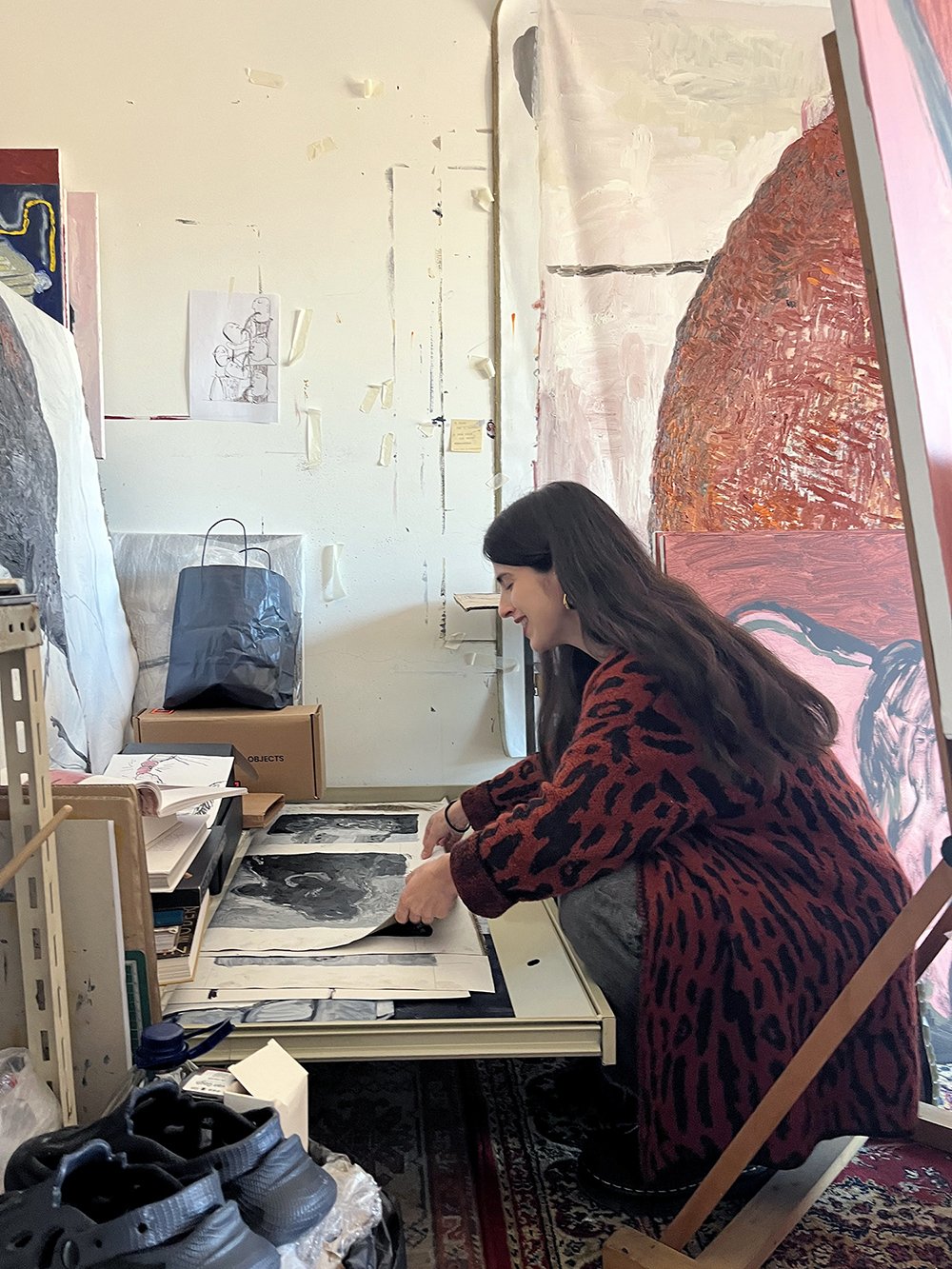
VERA MATIAS
INTERVIEW EIGHT
Vera Matias (Amarante, 1994) lives and works in Porto. Her practice always begins with drawing and is characterized by a strong connection between the material and the act of painting. The paint dictates the form, and a spontaneous process emerges with rules redefined with each mark. It is an evolving process that navigates through the multiple layers, applied, undone, damaged, and ultimately recovered. It all starts from a reaction to the world, into which the artist projects herself and which becomes an excuse to paint.
*
There was a point at which theory transitioned into practice. How did this transition happen and how did the two converge in your work? I pursued my academic journey in the opposite direction. I began studying Scenography at college, which is a very hands-on field. At that time, I missed having the opportunity to write, read, and reflect, as it was very urgent to produce. When I finished my degree, I did a master's degree in Art Theory and Criticism, exclusively theoretical. I truly enjoyed those years, but I missed getting my hands dirty. It was at that time that I started painting more seriously. When I graduated from college in 2018, I continued painting and have not stopped since. Theoretical thinking and reading accompanied this practice. So I would say that it wasn't necessarily a transition but rather a series of searches and trial and error that led me here. The paintings probably wouldn't exist without these two bases, which end up complementing and blurring each other. I'm not sure how to answer the question of whether the chicken or the egg comes first.
How would you describe your work process? First of all, it is very exciting. The rules are my own and they are not always the same. I believe my paintings are a reaction to the world: to a sensation, an event, an object, a reading, a person, or a conversation. They come from pain, joy, and all the gray areas in between. We often project our experiences onto things, using them as excuses to paint. In contrast, my work emphasizes the connection between the material and paint. I began with acrylics, then discovered oils, sparking my true obsession with painting. Sometimes I start with an idea, other times just a shape or a stain. And I go with the painting, adding and subtracting, doing and undoing. And things happen that I hate. I "ruin" things that I love and can't get back. It's a frustrating and crazy process, full of errors. Eventually, it ends up working. Sometimes I take forever on a painting. Other times it's too fast. Oh, and drawing. Drawing is fundamental for me. Maybe I would say that my process is being in the world and painting. I think that's it.
How do the narrative and characters emerge are worked on in your paintings? I feel the need to explore figuration in my work. This doesn't mean that I plan to create recognizable images, but I begin with something specific and retain certain qualities of that reference. This challenges me and enables me to express a thought through painting. Often, a painting just comes from something that caught my eye and gets transformed into the making. The characters appear first, and the narrative comes later. The distance allows me to see the story I wanted to tell but didn't know how.
What work of yours would you choose to define you at this moment? I recently painted using a completely different method than my usual approach. I spread the canvas on the floor, printed my feet dozens of times, and then walked up there for a long time, from one side to the other. I did this using oil paint and it took me longer to clean the feet and floor than it did to paint. This occurred after the March 10 elections, and I named it "Against each other"
Finally, what are you currently working on? What can we expect soon? Every day in paintings! Furthermore, at the end of this year, I will participate in an artistic residency for three months. I have spent some time preparing for that. Before that, I will have two paintings at the Cerveira Biennial, which opens in July and runs until the end of the year. For August, I am preparing a solo exhibition that will take place at Térmita, in Porto.
PT
Vera Matias (Amarante, 1994) vive e trabalha no Porto. A sua prática parte sempre do desenho e é caracterizada por um vínculo muito forte entre a matéria e o acto de pintar. A tinta comanda a forma e, de um modo muito espontâneo surge um processo com regras que vão sendo redefinidas a cada mancha. É um processo errante, que deambula pelas várias camadas aplicadas, desfeitas, estragadas, recuperadas. Tudo parte de uma reação ao mundo, onde a artista se projeta e que se transforma em pretexto para pintar.
*
No teu percurso deu-se uma transição da teoria para a prática. Como foi esta passagem e de forma se conciliaram as duas no teu trabalho? O meu percurso académico realizou-se no sentido inverso: comecei por estudar Cenografia na faculdade, uma área bastante prática. Nessa altura sentia falta da escrita, da leitura, de tempo para reflexão: era muito urgente produzir. Quando terminei a licenciatura, fiz um mestrado em Teoria e Crítica de Arte, exclusivamente teórico. Usufrui muito desses anos, mas senti falta de meter as mãos na massa. Foi nessa altura que comecei a pintar mais seriamente. Quando terminei a faculdade, em 2018, continuei a pintar e não parei até hoje. O pensamento teórico e a leitura foram acompanhando essa prática. Por isso diria que não se tratou necessariamente de uma transição, mas de uma espécie de círculo de procuras e tentativa-erro que acabou por me trazer até aqui. Provavelmente as pinturas não existiriam sem essas duas bases que acabam por se complementar e esbater. Se vem primeiro o ovo ou a galinha, não sei responder.
Como caracterizas o teu processo de trabalho? Antes de tudo, é muito excitante. São as minhas próprias regras e nem sempre são as mesmas. Por um lado, sinto que as pinturas vêm de uma reação ao mundo: a uma sensação, um acontecimento, um objeto, uma leitura, uma pessoa, uma conversa, uma dor, uma alegria, ou das linhas cinzentas que existem no meio disso tudo. Acho que acabas por projetar sempre o teu contexto e tudo se torna pretexto para pintar. Por outro lado, há no meu trabalho uma relação muito necessária com o material, com a tinta. Eu comecei por pintar com acrílicos e depois encontrei os óleos e veio daí a minha verdadeira obsessão com a pintura. Às vezes começo com uma ideia, outras vezes só com uma forma ou uma mancha. E vou indo com a pintura, adicionas e tiras, fazes e desfazes. E acontecem coisas que eu odeio, “estrago” coisas que adoro e que não consigo recuperar. É um processo frustrante e doido, cheio de erros. Eventualmente acaba por funcionar. Às vezes demoro uma eternidade numa pintura, outras vezes é demasiado rápido. Ah, e o desenho. O desenho é fundamental para mim. Se calhar, eu diria que o meu processo é estar no mundo e pintar. Acho que é isso.
De que forma surge e é trabalhada a narrativa e a personagem/figura nas tuas pinturas? Sinto necessidade de explorar a figuração no meu trabalho. Isto não significa que pretenda produzir imagens reconhecíveis, mas parto de qualquer coisa concreta e mantenho determinadas qualidades dessa referência. Isso desafia-me e permite-me produzir um pensamento na pintura. Muitas vezes, uma pintura vem apenas de alguma coisa que me captou o olhar e vai-se transformando no fazer. As personagens vão aparecendo e a narrativa vem depois. O distanciamento traz essa história que eu já queria contar e não sabia.
Que obra tua escolherias para te definir neste momento? Recentemente fiz uma pintura completamente diferente das que faço habitualmente, no que diz respeito ao método. Estendi a tela no chão e imprimi os meus pés dezenas de vezes, andei ali em cima um bom bocado, de um lado para o outro. Fiz isso com tinta a óleo e demorei mais tempo a limpar os pés e o chão do que a pintar. Isto foi depois das eleições de 10 de março e chamei-lhe “Uns contra os outros”.
Por último, em que estás a trabalhar atualmente e o que podemos esperar para breve? Nas pinturas, todos os dias! Para além disso, no final deste ano vou participar numa residência artística durante três meses e tenho passado algum tempo a preparar isso. Antes disso, vou ter duas pinturas na Bienal de Cerveira que inaugura em julho e fica até ao final do ano. Para agosto, estou a preparar uma exposição individual que terá lugar na Térmita, no Porto.

PEDRO O NOVO
INTERVIEW SEVEN
Pedro O Novo (Beja, 1992) lives and works in Lisbon. He draws inspiration from literature, especially the classics, for his characters and references. His references are worked into the painting in a literal but fanciful way, conveying his aura and immediacy.
In his paintings, there is a constant sense of revivalism and nostalgia for another time, one that he never lived. He is currently studying carpentry and plans to incorporate the discipline's rigor, method, and three-dimensionality into his pictorial universe.
*
Your work embodies romanticism, drawing upon references from the past. How would you describe it? I feel like a late Romantic; I live too much in the past. In addition to trying to illustrate thoughts and feelings, I look for authors who are similar to me. I absorb what I consider a "romantic spirit" or an "old soul" through reading. My subjects parallel my references, which are the classics. It is common in certain periods to revive others, which is what I want to happen to me. Sometimes in my paintings, I explore themes related to the 19th century and at other times I delve into medievalism. In fact, I think I'm more of a modernist than a contemporary artist. Or a surrealist, without meaning to. My work has to do with Art History, with a personification of what a painter was like in another era. That's what defines my work and the character I'm romanticizing.
How do you balance your painting with the recent discovery of carpentry, and how would you describe your work process? I once went into an antique frame shop. I asked prices, asked for quotes, and realized that what I wanted was economically inaccessible to me. I needed to learn how to do what I desired to achieve. I ended up finding a school where they teach this. I enrolled in the Carpentry course at Fundação Ricardo Espírito Santos Silva, an Arts and Crafts school. Since then, I have been exploring the universe of decorative arts, artisanal crafts, technical terms, and the creation process of the desired frames. All this learning will enter my imagination, what I want to represent pictorially. Currently, my work process draws heavily on my studies. However, lately, it has been more about the environment in my studio and school and the emotions they evoke in me.
What are the primary factors that shape the narrative structures in your work? Literature, namely the Classics, is the basis. I always wanted to represent recognizable subjects. More serially, it started with Peter Pan, Pinocchio, Don Quixote, and some of the stories from Ovid's Metamorphoses. Disney was one of my first great references. I remember liking the “making of” animated films. During my painting studies, I transformed my models into mythical and fantastical creatures such as nymphs, mermaids, princesses, fauns, and pirates. My references are characters, especially those worked on by other authors, with greater emphasis on those from Romanticism. I prefer being literal yet imaginative, with clear and vivid imagery. It takes me several years to finish an image, as I return to them repeatedly, but they usually never stray from the initial narrative.
How is “Alentejo” present in your practice? I have bucolic desires. I would like to live permanently in Alentejo, to have a life in the countryside, far from reality and current affairs. There is so much landscape in my painting, so many greens and many paths. They are not roads, I am not a naturalist. Although in the summer I paint in the countryside. The rurality in my work adopts a rustic appearance. I have flocks of easels, canvases leaning against the shade of trees, and brushes growing from the ground.
Finally, what are you currently working on? What can we expect soon? I am currently studying Carpentry. I will soon complete two frames and then begin constructing a chair in the D. Maria style. Next year, I plan to design and build a desk. I will continue to practice painting until I finish the course, then I'll focus on mastering three-dimensionality. I have solo and group shows coming soon. I'm currently dedicated to learning the methods, techniques, and rigor involved in this discipline.
PT
Pedro O Novo (Beja, 1992) vive e trabalha em Lisboa. O seu imaginário é povoado de referências e personagens importadas da Literatura, principalmente dos grandes clássicos. As suas referências são trabalhadas na pintura de forma literal mas fantasiosa, transportando daí a sua aura e imediatismo.
Nas suas pinturas são constantes um certo revivalismo e saudosismo de um outro tempo, um que não viveu. Atualmente a estudar marcenaria, pretende articular o rigor, o método e a tridimensionalidade da disciplina com o seu universo pictórico.
*
Do teu trabalho emana uma certa ideia de romantismo, de uma confluência de referências de outros tempos. Como definirias o teu trabalho? Sinto-me um Romântico tardio, vivo demasiado o passado. Para além de tentar ilustrar pensamentos e sentimentos, procuro autores que me sejam semelhantes. Absorvo através da leitura o que idealizo ser um “espírito romântico” ou uma “alma velha”. Os meus assuntos entram num paralelismo com as minhas referências, que são os clássicos e os antigos. É comum em certas épocas o revivalismo de outras, que é o que quero que aconteça comigo. Por vezes nas pinturas abordo temas referentes ao século XIX, outras vezes um certo medievalismo. Na verdade, acho que sou mais modernista do que contemporâneo, ou um surrealista sem querer. O meu trabalho tem a ver com a História de Arte, com uma personificação do que foi um pintor noutra época. É isso que define o meu trabalho e a personagem que estou a romancear.
Como caracterizas o teu processo de trabalho, e de que forma concilias com a pintura com a mais recente descoberta da marcenaria? Uma vez entrei numa loja de molduras antigas. Perguntei preços, pedi orçamentos, e percebi que o que eu quero é economicamente inacessível para mim. Então tenho de saber fazer o que eu quero ter. Acabei por encontrar uma escola onde ensinam isso, matriculei-me no curso de Marcenaria da Fundação Ricardo Espírito Santos Silva, uma escola de Artes e Ofícios. Desde então estou a descobrir o universo das Artes Decorativas, dos ofícios artesanais, dos termos técnicos e o modo como foram feitas as molduras que tanto ambiciono. Toda esta aprendizagem entrará no meu imaginário, no que quero representar pictoricamente. Atualmente o processo de trabalho deve muito ao estudo, nos últimos tempos é sobretudo alusivo ao ambiente do meu estúdio e da escola, às imagens que eles me suscitam.
Quais as principais influências para as várias construções de narrativas no teu trabalho? A Literatura, nomeadamente os Clássicos, são a base. Quis sempre representar assuntos reconhecíveis. De forma mais seriada começou pelo Peter Pan, Pinocchio, D. Quixote e alguns dos contos das Metamorfoses de Ovídio. A Disney é das primeiras grandes referencias, recordo-me de gostar muito dos “making of” dos filmes de animação. Enquanto estudei pintura transformei as modelos que tínhamos em ninfas, sereias e princesas, e os modelos em faunos e piratas. As minhas referências são personagens, sobretudo aquelas trabalhadas por outros autores, com maior ênfase nos do Romantismo. Preciso de ser literal mas fantasioso, gosto de ser entendido e que as imagens sejam imediatas. Levo muito tempo até terminar uma imagem, algumas vários anos, volto a elas recorrentemente, mas normalmente nunca se dispersam da narrativa inicial.
De que modo está presente o “Alentejo” na tua prática? Tenho desejos bucólicos. Gostava de viver permanentemente no Alentejo, de ter uma vida no campo, longe da realidade e da atualidade. Há tanta paisagem na minha pintura, tantos verdes e muitos caminhos. Não são estradas, não sou um naturalista, embora no Verão pinte no campo. A ruralidade no meu trabalho, adota uma aparência rústica. Tenho rebanhos de cavaletes, telas encostadas à sombra das árvores e pincéis que crescem do chão.
Por último, em que estás a trabalhar atualmente e o que podemos esperar para breve? Atualmente estou a estudar Marcenaria. Em breve acabo duas molduras, vou começar a fazer uma cadeira ao estilo D.Maria; no próximo ano desenho e construo uma secretária. Até terminar o curso vou mantendo a prática da pintura, depois virá a tridimensionalidade. Para breve tenho exposições, individuais e coletivas. Atualmente estou concentrado a aprender o que é o método, a técnica e o rigor.

ANA BALEIA
INTERVIEW SIX
Ana Baleia (Cascais, 1979) lives and works in São Luís, Odemira. With fashion design as her background, she had a turning point when moving to Alentejo. As a result of several influences, a multidisciplinary artistic practice emerges, focusing on textile art. Sustainable and focused on changing the environmental paradigm.
She incorporates literary and theatrical references into several installation moments. She focuses very intensely on researching textile waste and the potential of upcycling, such as her TEX REX project.
*
Your artistic practice links to fashion and scenography. Can you share your journey and how you define your practice? I studied Fashion Design at the Faculty of Architecture of Lisbon. I was especially interested in designer fashion, the concepts approached by the creators, and the entire mise en scène. During this time, I have developed an interest in upcycling fabrics and clothing with a past life. After completing the course I designed for mainstream brands, I quickly realized that the concept of disposable fashion did not appeal to me. I even developed some antibodies towards this industry and moved away from it completely. The decision to live in Alentejo, where I have been for 16 years, allowed me the space to explore more paths, always using textiles as the main raw material. As a costume designer, I established collaborations with directors and choreographers that I continue to this day. This experience with the performing arts and stage design was enlightening, as it allowed me to experiment with fabric manipulation more creatively and dynamically. I adopted new methods such as dyeing, tearing, painting, and burning. I also started exhibiting installation works, as part of festivals and group exhibitions. I believe that when I create something, a conversation happens between me and the fabrics I use. The materials inspire me and I respond with my creative ideas. This exchange helps me to communicate my vision and tell the story I want to share. Currently, I fluctuate between visual artist, costume designer, and designer. My artistic practice revolves around using textiles as a medium, focusing mainly on repurposing discarded materials.
Waste and consequent upcycling are the basis of your research, particularly in projects like Tex Rex. How would you define this process? Working with textile waste and receiving clothes that others no longer wanted was a process that quickly became a kind of monster I was no longer able to master. There was too much clothing. I couldn't get rid of it. I felt overwhelmed and concerned about the socio-environmental impact of this issue. The idea of shredding that clothing began to emerge as a possibility, a way of obtaining a "new" material and bringing other approaches to textile upcycling, and so it was. Tex Rex is a research project about textile reuse and involves the mechanical shredding of clothing items, turning them into rags. This procedure worked as a trigger that unlocked my creative process and allowed me to defeat the monster.
What is the potential of textile waste and what is the creative potential yet to be explored in your work? Textiles are manufactured with various natural and artificial fibers, pure and composite, each with their characteristics and properties. Textile fibers can protect, heat, and insulate. Its production requires work, knowledge, technical mastery, and lots of water. It also involves polluting processes. Textile waste is therefore a material with immense value and enormous potential. It is possible to explore its use in architecture or equipment design and reintroduce it to the market in a non-clothing form. In my work, I am interested in mixtures, textures, colors, patterns, labels, and buttons without discrimination of fibers. My focus is to explore the intersection of rural traditions and modern excesses while also advocating for environmental and social justice and promoting sustainability. In a pile of used clothing, one can find not only a variety of fabrics but also a cross-section of society, themes that move and inspire me. I intend to continue exploring this path.
The theme of 'memory' is evident in many of your artworks, reflecting what was impressed upon each piece. How is this reflected in your work? One of the things that interests me most about textile waste is this layer - that of stories brought by the clothes used for my work. It even happens in the case of clothes whose origin I don't know, because in each bag I open it is possible to get a glimpse of the age, social class and way of life of the person to whom it belonged. The idea of freezing memories with my work touches me deeply, recording a moment or a person through a piece of clothing. Somehow, I feel that I am touching something transcendent. I am rescuing not only the material but also the immaterial.
Finally, what are you currently working on? What can we expect soon? I just dismantled an exhibition in Torres Vedras and am now creating more pieces for my project: Figure Out - Characters of Literature. I will complete all the puppets and small props for the theater production of 'Don Quixote', directed by Pedro Giestas, by April. Still in April, at the invitation of the artist Leonor Morais, I will do an artistic residency with her, ´Fio´, where drawing and textiles connect and dialogue and which will result in an exhibition in Aljezur, by Associação Tertúlia. Next May I will start a theater co-creation, with EsTe (Estação Teatral do Fundão), staged by Sofia Cabrita, and will be presented in October. In the coming months, I will also be in artistic residency at Cultivamos Cultura, with the 'Credo´ project, this residency will be divided into 3 parts, and it will take place between Odemira and Lisbon. That's all for now, at least in the short term.
PT
Ana Baleia (Cascais, 1979) vive e trabalha em São Luís, Odemira. Tendo o design de moda como background, teve um momento de viragem na mudança para o Alentejo. Resultado de várias influências surge uma prática artística multidisciplinar, com enfoque na arte têxtil. Sustentável e focada na mudança de paradigma ambiental.
O seu imaginário é povoado de referências literárias e teatrais, que interpreta em vários momentos instalativos. Foca-se de forma bastante intensa na investigação dos desperdícios têxteis e nas potencialidades do upcycling, como é exemplo o seu projeto TEX REX.
*
O teu trabalho parte de um background ligado à moda e cenografia. Como foi o teu percurso e como definirias a tua prática artística? Estudei Design de Moda, na Faculdade de Arquitetura de Lisboa, interessava-me especialmente a moda de autor, os conceitos abordados pelos criadores e toda a mise en scène, durante esse período surgiu também o gosto pelo reaproveitamento de materiais, pelo uso de tecidos e roupas com vidas passadas. Depois do terminar o curso desenhei para marcas main stream e cedo percebi que a moda descartável não era para mim, criei até alguns anticorpos em relação a esta indústria, afastando-me totalmente. A decisão de viver no Alentejo, onde estou há 16 anos, permitiu-me ter espaço para explorar mais caminhos, utilizando sempre os têxteis como matéria-prima principal. Enquanto figurinista, estabeleci colaborações com encenadores e coreógrafos que mantenho até hoje. Este contacto com as artes performativas e com o espaço cénico foi revelador, permitiu-me explorar outras formas de manipular os tecidos, uma abordagem mais plástica e experimental, adoptei novos métodos como tingir, rasgar, pintar, queimar. Comecei também a expor trabalhos de instalação, integrados em festivais e exposições coletivas. Sinto que no meu processo criativo é estabelecido um diálogo entre mim e os tecidos que escolho trabalhar, há um input trazido pelo material ao qual respondo, esta troca funciona como uma ferramenta que me ajuda a comunicar a minha ideia e a contar aquela história. Atualmente vou flutuando entre a artista visual, a figurinista e a designer, a minha prática artística está intrinsecamente ligada ao meu media de eleição: o Têxtil - transversal a todos os projetos que desenvolvo, com especial foco no uso do desperdício. Prefiro trabalhar com o que já foi usado e descartado.
O desperdício e consequente upcycling são base da tua investigação, nomeadamente em projetos como o Tex Rex. Como definirias este processo? Trabalhar com o desperdício têxtil, recebendo as roupas que os outros já não querem, foi um processo que rapidamente se tornou numa espécie de monstro que deixei de conseguir dominar. A roupa que recebia era tanta que não tinha capacidade de escoar o material, fiquei aterrada com todo este excesso e com a problemática socioambiental relacionada com o tema. A ideia de triturar aquela roupa começou a surgir como uma possibilidade, uma forma de obter um "novo" material e trazer outras abordagens para o upcycling têxtil, e assim foi. O Tex Rex é um projeto de pesquisa sobre reutilização têxtil e parte da trituração mecânica das peças de roupa, transformando-as em farrapos. Este procedimento funcionou como um gatilho que desbloqueou o meu processo criativo e que me permitiu ir vencendo o monstro.
Quais as potencialidades dos desperdícios têxteis e qual o potencial criativo ainda por explorar no teu trabalho? Os têxteis são fabricados com diversas fibras, naturais e artificiais, puras e compostas, cada qual com as suas características e propriedades, as fibras têxteis podem proteger, aquecer, isolar. A sua produção requer trabalho, conhecimento, domínio técnico, e muita água, envolvendo também processos poluentes. O desperdício têxtil é por isso um material com imenso valor e enorme potencial, pode ser explorado no campo da arquitetura ou design de equipamento e voltar a entrar no mercado sob outra forma que não roupa. No meu trabalho interessam-me as misturas, as texturas, as cores, os padrões, as etiquetas, os botões, sem discriminação de fibras. Tenho tocado temas como a justiça e a sustentabilidade ambientais e sociais, mas também procuro explorar os ritos e as tradições, especialmente as mais ligadas à ruralidade e cruzar esse mundo com o dos atuais excessos. Num monte de roupa usada está uma amostra da sociedade, onde se encontra não só uma diversidade de fibras mas também de assuntos que me movem e comovem, pretendo continuar a explorar esse caminho.
É bastante visível em várias das tuas peças o conceito de ‘memória’, daquilo que ficou impresso em cada uma das peças que são trabalhadas por ti. Como é isto interpretado no teu trabalho? Uma das coisas que mais me interessa no desperdício têxtil é essa camada - a das histórias, trazidas pelas roupas usadas para o meu trabalho. Isto acontece mesmo no caso da roupa cuja origem desconheço, porque em cada saco que abro é possível ter um vislumbre da idade, da classe social e do modo de vida da pessoa a quem pertenceu. Toca-me profundamente a ideia de congelar memórias com o meu trabalho, registar através de uma peça de roupa um momento ou uma pessoa, de algum modo sinto que estou a mexer com o que é transcendente, resgatando não só o que é material mas também o imaterial.
Por último, em que estás a trabalhar atualmente e o que podemos esperar para breve? Acabei de desmontar uma exposição em Torres Vedras e estou agora a produzir mais peças do meu projecto Figure Out - Personagens da Literatura. Em Abril vou terminar as marionetas e pequenos adereços que estou a fazer para o espetáculo de teatro de objetos ´Dom Quixote´, com direção do Pedro Giestas. Ainda em Abril, a convite da artista Leonor Morais, irei fazer com ela uma residência artística, ´Fio´, onde o desenho e os têxteis se ligam e dialogam e da qual resultará uma exposição em Aljezur, pela Associação Tertúlia. Em Maio inicio uma co-criação de teatro, com a EsTe (Estação Teatral do Fundão), com encenação da Sofia Cabrita, terá apresentação em Outubro. Nos próximos meses vou estar também em residência artística na Cultivamos Cultura, com o projecto 'Credo´, esta residência será dividida em 3 partes, acontecerá entre Odemira e Lisboa. E pronto, a curto prazo, será isto.

ALEXANDRE CAMARAO
INTERVIEW FIVE
Alexandre Camarao lives and works in Lisbon. He started making electronic music even before visual arts. His work spans a variety of media, including drawing, painting, video, music, and tapestry. The drawing is always the core.
The music is imported from an electronic universe of sequencers and synthesizers in a highly visual and intuitive way. The rhythmic presence of his sound compositions extends to the other supports in which he composes, namely the tapestry. Alexandre's work is an extensive and complex composition of drawings, words, images, and sounds. But as important as each of these elements is the "web" that supports and articulates the sets that these same elements form.
*
Your work revolves around various media, such as drawing, painting, or tapestry. How do they interconnect and dialogue with each other? My work involves the assemblage of images, sounds, and words, and also the appropriation of multiple references such as art history, mythology, decorative arts, design, and music, oscillating between elements of pop and erudite culture, without hierarchies. The drawing is always the foundation, serving as both a preparatory element for other drawings, as well as a thought for tapestries and paintings. The relationship between the drawings and the final artwork may not always be direct and chronological. Sometimes, a 4-year-old drawing may be used as a base for a new painting or tapestry. However, drawing always ends up being an extension of thought and design. On the other hand, drawing, painting, and weaving have different speeds, which helps me in the creative processes of each of the disciplines. "Jumping" between them helps me build a thought about what I do.
Music, particularly electronic music, is frequently imported into your practice. How would you define this process? This process is always intuitive. I started making electronic music even before visual arts. I'm from the generation of sequencers like Logic, which graphically presents music. I read musical staves poorly, and for me, the musical creative process has always been very visual, not only through sequencers but also through the synthesizers themselves. I have always tried to have as much visual and tactile information as possible so they can be programmed more immediately. I've recently been using semi-modular synthesizers that literally use "wires" to connect to each other to build sounds and musical sequences. The use of rhythm is very prominent in my music compositions. All these aspects end up having their relationship with the materiality and construction of tapestries. Formal decisions here also involve a lot of intuition, that is, a kind of faith that something we don't know exactly how it will turn out will eventually work out. The process of creating tapestries involves many variations. Sketches on paper, digital simulations, making and even unmaking parts of the tapestries. However, the rhythmic composition also happens here, and the 'deviation', which is always welcome in these artistic matters, also occurs in textile production.
In your works, there is a significant presence of written words. How do you incorporate them and what impact do they have on the final product? The 'word' appeared mainly since my artistic residency in Los Angeles, where I began to explore the visual and graphic elements of words, including the meanings themselves, in font design, text visuality, song lyrics, and phonetics, following the basis of Concrete Poetry started in Brazil - a country that shares strong cultural ties with Portugal. These elements and questions are reflected and explored in tapestry methodologies and techniques, in their rhythms, different speeds, and materiality. A textile line can serve as a metaphor for the simple act of drawing a line on paper. The line, in tapestry, projects the drawing but, at the same time, creates its materiality, literally. For example, how most music is currently produced, through a precise and continuous repetition of sounds, loops, and the use of stutter effects, in addition to being similar to tapestry techniques, contributes to a metamorphosis of letters and their formal and phonetic characteristics. In recent tapestry works, I used material from musicians such as DJ Rashad, Robyn, or Brazilian singer Gal Costa, but also from artists/designers such as New Yorker Ben Duvall and the Portuguese duo Sara & André.
In addition to multidisciplinarity, collaboration is essential in your work process, visible in the duo ABCC (Alexandre Camarao+Bernardo Simões Correia). How do you transition between your work and that of the ABCC? In general, my work develops from the feeling that the continuous flow of images to which we are exposed - artists like everyone else - causes some blindness. The motivation to work (I imagine it is similar for all artists) consists of not supporting being a passive and uncritical vehicle of this flow. Although I believe that there is no point in trying to “oppose” this flow or seeking a sheltered position “outside” the flow - which would be the same as absenting ourselves from the world... This position is very similar to that of artist Bernardo Simões Correia towards images of the world. The images resulting from our work seem to come into tension, either autonomously or with each other, so we are not led to produce a stylistic “series” properly.
Finally, what are you currently working on? What can we expect soon? I am back to creating electronic music and planning to release it as a digital album shortly. I continue to develop the tapestry work, once again using the music of Gal Costa but also of Aphex Twin. The production of drawings (but less painting) is continuous - always! Finally, ABCC has several projects in hand: one of them consists of a workshop production that will materialize in the limited edition of 4 newspapers and a sound performance, a special edition for the artist Oscar Holloway in his magazine KNIPPERDOLLING, from Barcelona, and the graphic production of a book.
PT
Alexandre Camarao (Lisboa, 1972) vive e trabalha em Lisboa. Começou a fazer música electrónica ainda antes das artes visuais. O seu trabalho estende-se por diversos media, nomeadamente o desenho, a pintura, o vídeo, a música e a tapeçaria. A base é sempre o desenho.
A música surge de forma intuitiva e marcadamente visual, importada de um universo eletrónico de sequenciadores e sintetizadores. A presença rítmica das suas composições sonoras dilata-se para os outros suportes em que compõe, nomeadamente a tapeçaria. O trabalho do Alexandre configura-se como uma extensa e complexa composição de desenhos, palavras, imagens e sons. Mas tão importante como cada um desses elementos, é também a trama que sustenta e articula os conjuntos que esses mesmos elementos formam.
*
O teu trabalho gravita em torno de vários media, como o desenho, a pintura ou a tapeçaria. De que forma se interligam e dialogam entre si? O meu trabalho baseia-se na agregação de imagens, sons e palavras, e na apropriação de múltiplas referências como a história da arte, a mitologia, as artes decorativas, o design e a música, oscilando entre elementos da cultura pop e erudita, sem hierarquias. A base é sempre o desenho. Tanto como elemento preparatório de outros desenhos, como pensamento para tapeçarias e pinturas. A relação pode não ser directa e cronológica. Eventualmente posso usar um desenho com 4 anos para uma nova pintura ou tapeçaria. Mas o desenho acaba sempre por ser uma extensão do pensamento e é também desígnio. Por outro lado, desenhar, pintar e tecer têm velocidades diferentes, o que, para mim, me ajuda nos processos criativos de cada uma das disciplinas. Ir "saltando" entre elas, ajuda-me a construir um pensamento sobre o que faço.
A música, particularmente a música eletrónica, é importada recorrentemente para a tua prática. Como definirias este processo? Este processo é sempre intuitivo. Comecei a fazer música electrónica ainda antes de artes visuais. Sou da geração dos sequenciadores como o Logic, que apresentam a música de uma forma gráfica. Leio mal pautas, e para mim, o processo criativo musical sempre foi muito visual, não só através dos sequenciadores como dos próprios sintetizadores, os quais sempre procurei ter com o máximo de informação visual e táctil para serem mais imediatamente programados. Recentemente tenho usado sintetizadores semi-modulares que literalmente usam "fios" para se ligarem uns aos outros na construção de sons e sequências musicais. A presença rítmica é muito preponderante nas minhas composições sonoras. Todos estes aspectos acabam por ter uma relação própria com a materialidade e construção da tapeçaria. As decisões formais, passam aqui também muito por intuições, ou seja, um espécie de fé de que algo que não sabemos bem como irá ficar, irá eventualmente resultar. Ao longo do processo há muitas variações, claro. Esboços em papel, simulações digitais, fazer e até desfazer partes das tapeçarias. No entanto, a composição rítmica também aqui acontece, e o "desvio", que é sempre bem vindo nestas questões artísticas, também tem lugar na produção têxtil.
Nas tuas obras existe um lugar importante reservado à palavra escrita, bastante visível nas tuas obras têxteis. Como surge a palavra e que marca deixa na obra final? A palavra surge principalmente desde a minha residência artística em Los Angeles, onde comecei a explorar os elementos visuais e gráficos das palavras, incluindo os próprios significados, no desenho de fontes, na visualidade do texto, nas letras de música e na fonética, seguindo a base da Poesia Concreta iniciada no Brasil - um país que partilha fortes laços culturais com Portugal. Estes elementos e questões são reflectidos e explorados nas metodologias e técnicas de tapeçaria, nos seus ritmos, velocidades diferenciadas e materialidade. Uma linha têxtil pode funcionar como uma metáfora para o simples acto de desenhar uma linha numa folha de papel. A linha, na tapeçaria, projecta o desenho mas, ao mesmo tempo, cria a sua materialidade, literalmente. A título de exemplo, a forma como a maior parte da música é produzida atualmente, através de uma repetição precisa e contínua de sons, de loops e da utilização de efeitos stutter, para além de ser semelhante às técnicas de tapeçaria, contribui para uma metamorfose das letras e das suas características formais e fonéticas. Nos últimos trabalhos de tapeçaria, tenho vindo a utilizar material de músicos como DJ Rashad, Robyn ou a cantora brasileira Gal Costa, mas também de artistas/designers como o nova-iorquino Ben Duvall e a dupla portuguesa Sara & André.
Para além da multidisciplinaridade, a colaboração é essencial no teu processo de trabalho, visível no duo ABCC (Alexandre Camarao+Bernardo Simões Correia). Como é feita a passagem entre o teu trabalho individual e o dos ABCC? De uma forma geral o meu trabalho individual desenvolve-se a partir da sensação de que o fluxo contínuo de imagens ao qual estamos expostos - os artistas como todos os outros - provoca uma “cegueira”. A motivação para trabalhar (imagino que seja semelhante para todos os artistas) consiste em não suportar ser um veículo passivo e a-crítico desse fluxo, embora acredite que de nada serve tentarmos “contrariar” esse fluxo ou procurarmos uma posição resguardada “fora” do fluxo - o que seria o mesmo que ausentarmo-nos do mundo...
Esta posição perante as imagens do Mundo é muito semelhante à do artista Bernardo Simões Correia. As imagens resultantes do nosso trabalho parecem entrar em tensão, quer autonomamente quer entre si, pelo que não somos levados a produzir propriamente “séries” estilísticas.
Por último, em que estás a trabalhar atualmente e o que podemos esperar para breve? Neste momento, voltei a desenvolver mais a produção de música electrónica com vista a um futuro lançamento de um álbum digital. Continuo a desenvolver o trabalho em tapeçaria, uma vez mais recorrendo à música de Gal Costa mas também de Aphex Twin. A produção de desenho (mas menos pintura) é contínua - sempre! Por fim, os ABCC estão com vários projectos em mãos: um deles consiste na produção de um workshop que se irá materializar na edição limitada de 4 jornais e uma performance sonora, uma edição especial para o artista Oscar Holloway na sua revista KNIPPERDOLLING de Barcelona, e a produção gráfica de um livro.