
17 Feb — 15 Mar 2024 | ÉVORA
Com o olhar; caminhando
No gerúndio, o tempo é demorado, deixando-se demorar, demorando, embora a ação seja no momento e esteja em andamento. A pintura de Diana Cerezino convida-nos ao mesmo particípio presente no verbo “olhar”.
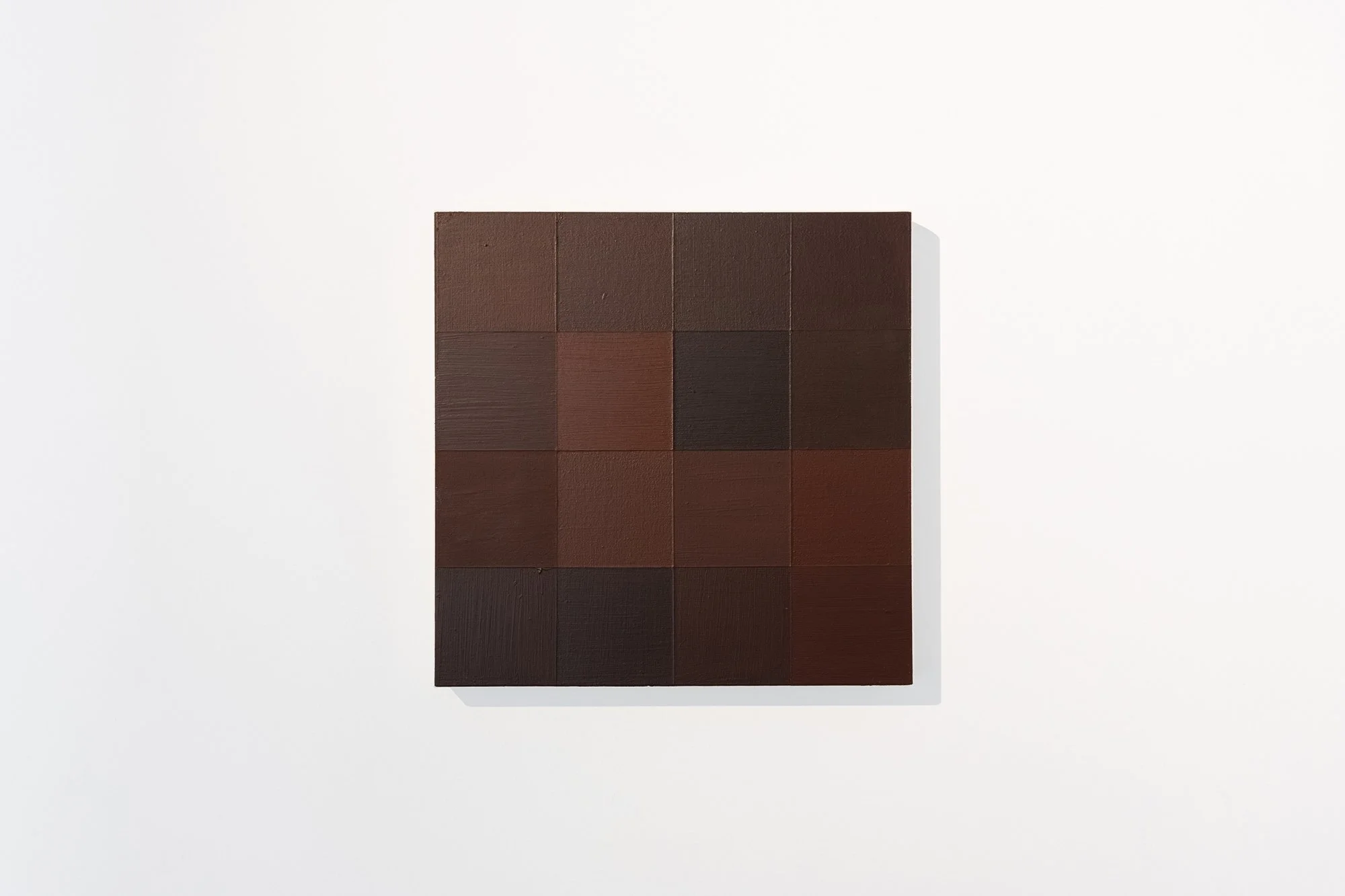
Num primeiro momento, as telas são um engodo para o olho, são estáticas e pintam-se com a mesma matiz. Vistas de longe, os olhos lêem a pintura como única e apenas com lentos passos em volta se revelam. São necessárias passadas curtas – devagar e caminhando – numa espécie de movimento pendular em torno do quadro. Quando nos aproximamos vemos os quadrados em separado, o que é o brilho, o que é matte, o que é plano e o que é profundo; quando nos afastamos revelam-se como um monobloco com diferentes acentuações.
Atrevo-me a dizer que não é possível olhar antes de ver; que as peças de Cerezino acrescentam olhar apenas depois de andar, num gesto performativo de ligação entre o olho-lente (científico) e o olho-observador (contemplativo). E bem sabemos como são distintas as ações. Podemos ver sem nunca olhar e, para olhar, é preciso abrandar e forçar a paragem. Agora, e na galeria, vemos a cortina que cobre um vão por desvelar, mas olhamos o desenrolar do tecido no chão; vemos uma jarra de tulipas brancas sobre a mesa, mas pensamos além da transparência do vidro. Vemos os mosaicos hidráulicos verdes a pavimentar a galeria, mas olhamos a espessura das paredes. Vemos rigidez no monotom das pinturas de Cerezino, mas olhamos a textura das pinceladas e o viajar da luz pelos tons – germinando ou apagando a cor, com mais ou menos sombra.
A geometria do quadrado tem uma presença significativa no processo de Cerezino, é mesmo uma linguagem – e o processo é fundamental no pensamento criativo da artista, como terapia meditativa. Para o espectador, o olhar caminha de quadrado em quadrado, mirando os limites quase imperceptíveis na subtil mudança de cor. Uma célula agrupa-se em conjuntos maiores de 40x40, 60x60, 80x80, 120x120, 140x140, ou infinito, mantendo o rigor do quadrado, ou alongando para formas mais panorâmicas de 70x90 ou 90x40. A grelha que à partida seria tida como uma estrutura limitadora, permite-lhe acomodar um campo lúdico onde explora as transformações da tonalidade. A cada quadrado um pigmento, uma saturação, um brilho. A cada vibração um novo quadrado. E para Diana Cerezino, tanto importa o impacto do fim sobre o espectador, que procura por besouros e outros insectos entre arbustos (Beetles in the Bush, 2020), como do meio (processo), que é um exercício pessoal e introspectivo.
Neste novo corpo de trabalho centrado nas tonalidades da taipa (sobretudo as peças Cultivo e Germinar, 2024), Diana Cerezino semicerra os olhos sobre campos de trigo depois das colheitas, caminhando pela secura da terra "plana, lisa como as palmas das tuas mãos, sem acidentes orográficos dignos desse nome". (1 SARAMAGO, José, As Pequenas Memórias, p. 12)
In the gerund, time is slow, allowing it to linger, lingering, although the action is in the moment and is in progress. Diana Cerezino’s paintings invite us to the same present participle in the verb ‘look’.
At first, the canvases are a decoy to the eye, they are static and painted with the same hue. And if viewed from a distance, the painting appears as homegenous, but as one approaches and takes slow steps around it, the eyes begin to reveal the details. Short strides are necessary – slowly and walking – in a sort of pendulum movement around the painting. Upon approaching, the squares appear distinct: some are glossy, some matte, some flat, and some deep. However, from afar, they appear as a single block with varying light accents.
I dare say that one cannot look before seeing; to which Cerezino’s pieces add ‘looking only after walking’, in a performative gesture of connection between the eye-lens (scientific) and the eye-observer (contemplative). And we are aware of the vast difference in actions. We can perceive without ever ‘looking’, and ‘to look’ we must slow down and compel ourselves to stop. As we enter the gallery, we notice a curtain that conceals something yet to be revealed. But instead of focusing on the curtain, we observe the fabric unfolding on the floor. Similarly, there is a vase of white tulips on the table, but we see through the transparency of the glass and contemplate beyond it. We see the green mosaics paving the gallery, but we look at the thickness of the walls. We see rigidity in the monotone of Cerezino’s paintings, but we look at the texture of the brushstrokes and the travel of light through the tones – germinating or erasing the color, with more or less shadow.
The geometry of the square has a significant presence in Cerezino’s process, it is even a language - and the process is fundamental in the artist’s creative thinking, and also as meditative therapy. For the viewer, the gaze moves from square to square, looking at the almost imperceptible limits in the subtle change of color. A cell is grouped into larger sets of 40x40, 60x60, 80x80, 120x120, 140x140, or infinity, maintaining the rigor of the square, or stretching to more panoramic shapes of 70x90 or 90x40. The grid, which would initially be seen as a limiting structure, allows it to accommodate a playful field where the transformations of tonality are explored. Each square has a pigment, a saturation, a brightness. With each vibration, a new square appears. For Diana Cerezino, the final impact on the viewer, who ‘looks for beetles and other insects among bushes’ (Beetles in the Bush, 2020), is as important as the middle (process), a personal and introspective exercise.
In this new series of work centered on the tones of rammed earth (especially the pieces Cultivo and Germinar, 2024), Diana Cerezino half-closes her eyes over wheat fields after the harvest; walking through the dryness of the earth “flat, smooth as the palms of your hands, without orographic features worthy of that name”. (1 SARAMAGO, José, As Pequenas Memórias, p.12)
Curated by Frederico Vicente
Diana Cerezino

Com o olhar; caminhando | Diana Cerezino
Com o olhar; caminhando | Diana Cerezino

Com o olhar; caminhando | Diana Cerezino

Com o olhar; caminhando | Diana Cerezino

Com o olhar; caminhando | Diana Cerezino

Com o olhar; caminhando | Diana Cerezino

Com o olhar; caminhando | Diana Cerezino

Com o olhar; caminhando | Diana Cerezino

Com o olhar; caminhando | Diana Cerezino

Com o olhar; caminhando | Diana Cerezino

Com o olhar; caminhando | Diana Cerezino

Com o olhar; caminhando | Diana Cerezino

Com o olhar; caminhando | Diana Cerezino